
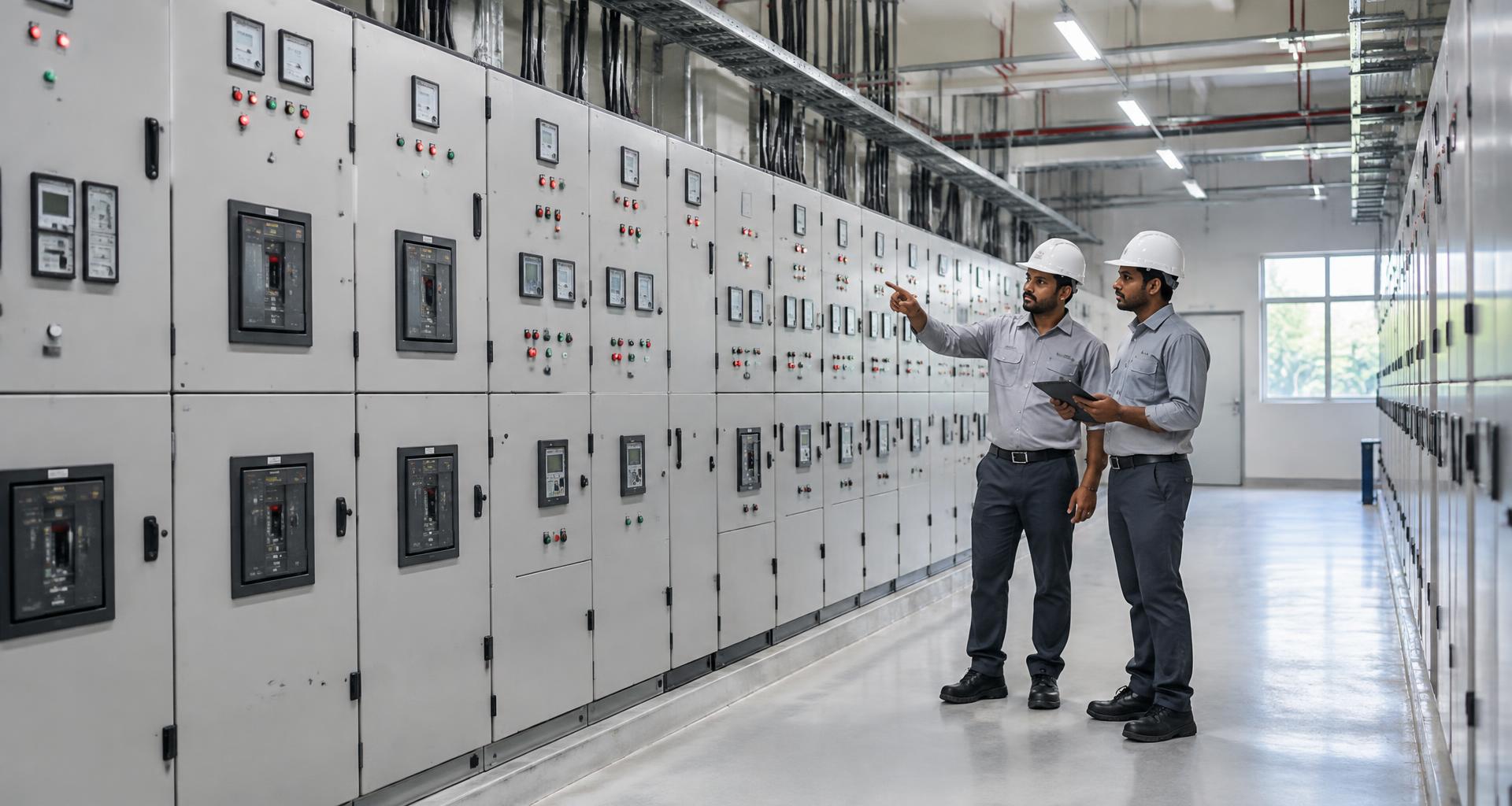
Central HVAC Chiller Plant Preventive Maintenance for IT Parks & Commercial Campuses
Engineering manual on central chiller plant preventive maintenance, condenser descaling, cooling tower efficiency, AHU balancing, and resolving Low Delta-T Syndrome in Bengaluru IT parks.

Central HVAC chiller plant preventive maintenance in Bengaluru commercial facilities combines water-cooled centrifugal or screw chiller servicing, automated condenser tube brushing, cooling tower chemical treatment, and AHU CFM balancing. JTechno Associates maintains over 300 high-capacity installations, preventing Low Delta-T Syndrome and cutting chiller energy consumption by 15% to 22%.
Key Engineering Highlights
- Condenser tube scaling as thin as 0.6 mm increases chiller compressor energy consumption by over 20% due to impaired heat transfer.
- Cooling tower approach temperature must be maintained under 2.8°C to prevent excessive head pressure in water-cooled chillers.
- Low Delta-T Syndrome (return water temp lower than design) forces unnecessary chillers online; resolving it requires 2-way control valve calibration.
- Non-destructive Eddy Current Testing of copper condenser and evaporator tubes every two to three years prevents sudden catastrophic refrigerant-water tube breaches.
- Indoor air handling units (AHUs) require quarterly static pressure balancing and variable frequency drive (VFD) modulation for optimal CFM distribution.
Central Chiller Plant Operating Dynamics Across Bengaluru Tech Campuses
In commercial office parks and data-heavy development campuses across Bengaluru—such as Manyata Embassy Business Park, Whitefield, and Electronic City—central HVAC chiller plants account for 45% to 60% of total building electrical energy consumption. Operational efficiency in these high-capacity systems is the single largest determinant of facility operational expenditure (OPEX) and carbon footprint.
Operating modern central HVAC plants requires constant balance across multiple thermodynamic circuits: the primary and secondary chilled water loops, the condenser water loop, the open-circuit cooling tower system, and air-side distribution networks. Minor deviations in approach temperatures, refrigerant charge, water chemistry, or airflow balancing cascade into massive energy penalties, equipment short-cycling, and tenant comfort complaints.
Water-Cooled Screw vs. Centrifugal Chillers: Operating Parameters & Maintenance
Commercial campuses typically employ water-cooled screw chillers (for modular base loads from 150 to 500 TR) and high-efficiency centrifugal chillers (for massive continuous cooling loads from 500 to 2000 TR). Centrifugal chillers utilize variable-inlet guide vanes and VFD-driven impellers operating at high rotational speeds, demanding exceptional oil lubrication cleanliness and precision thrust bearing clearances.
Preventive maintenance protocols mandate logging key thermodynamic parameters hourly: evaporator approach temperature (difference between leaving chilled water and refrigerant evaporating temperature, target < 1.0°C), condenser approach temperature (difference between leaving condenser water and refrigerant condensing temperature, target < 1.5°C), compressor oil differential pressure, and oil sump temperature. An elevating approach temperature is the primary early-warning indicator of heat exchanger tube fouling or refrigerant undercharge.
Condenser Tube Descaling, Eddy Current Testing & Refrigerant Leak Audits
Open cooling tower circuits introduce airborne dust, biological organics, and dissolved calcium/magnesium minerals into condenser heat exchangers. Over time, these minerals precipitate onto the internal surfaces of copper tubes as hard scale. Even an imperceptible 0.6 mm layer of calcium scale acts as a severe thermal insulator, forcing the compressor to work against elevated head pressures and increasing electrical power draw by over 21%.
Comprehensive maintenance involves bi-annual mechanical tube descaling using high-speed rotating nylon or brass brushes with water flush. Where heavy silicates or scale have hardened, controlled chemical descaling using inhibited sulfamic acid formulations is performed with neutral pH passivation. Furthermore, every 24 to 36 months, condenser and evaporator tubes undergo non-destructive Eddy Current Testing (ECT) to detect tube wall thinning, pitting, and stress corrosion cracking before a tube ruptures, which would flood the refrigerant circuit with water.
- Log evaporator and condenser approach temperatures; flag readings exceeding 1.5°C.
- Perform seasonal mechanical tube brushing on all water-cooled shell-and-tube condensers.
- Execute non-destructive Eddy Current Testing on heat exchanger tubes every 2–3 years.
- Check compressor oil acidity (TAN < 0.10 mg KOH/g) and replace full-flow oil filter cartridges.
- Conduct electronic halogen sniffer and ultrasonic refrigerant leak detection on all joints and service valves.
Cooling Tower Water Chemistry, Approach Temperature & Legionella Control
Induced-draft cooling towers reject building heat into the ambient atmosphere through evaporative cooling. Tower performance is governed by the approach temperature—the difference between the cold water leaving the tower and the ambient wet-bulb temperature. In Bengaluru's climate, a well-maintained cooling tower achieves an approach temperature between 2.0°C and 2.8°C.
Maintaining tower efficiency requires strict water treatment to prevent scaling, biological fouling, and microbiological risks like Legionella pneumophila. Automatic blowdown controllers regulate Cycles of Concentration (CoC) between 4.0 and 5.5, preventing salt saturation while minimizing freshwater consumption. Bi-weekly chemical dosing introduces oxidizing biocides (sodium hypochlorite / chlorine dioxide) alternated with non-oxidizing isothiazolinone biocides, paired with phosphonate scale inhibitors. Bi-annual mechanical cleaning cleans sludge from tower cold basins and removes mineral crusts from PVC drift eliminators.
Overcoming Low Delta-T Syndrome & Optimizing Variable Primary Flow (VPF)
One of the costliest operational inefficiencies in corporate HVAC operations is 'Low Delta-T Syndrome.' Commercial chiller plants are engineered for a design temperature differential (Delta-T) between supply and return chilled water—typically 5.5°C (supply at 6.7°C, return at 12.2°C). In practice, faulty 3-way bypass valves, malfunctioning AHU 2-way control valves, oversized coils, or dirty air filters cause return water to come back at 8.5°C or 9.0°C (a Delta-T of only 2.0°C to 3.0°C).
When Delta-T collapses, chilled water pumps must pump twice as much water to meet building cooling demand, and plant operators are forced to turn on additional chillers simply to satisfy flow rate limits—even though the running chillers are operating at half capacity. JTechno Associates audits facility control loops, recalibrating modulating actuator valves, replacing malfunctioning 3-way valves with pressure-independent control valves (PICVs), and implementing smart VPF pump staging algorithms to restore full design Delta-T.
Air Handling Unit (AHU) Static Pressure Balancing & Indoor Air Quality
The air-side network delivers conditioned, filtered air across large corporate floor plates. Air Handling Units (AHUs) require rigorous preventative maintenance: dynamic belt tension calibration, blower fan bearing lubrication, motor winding insulation testing, and cooling coil face cleaning. Clean coils ensure optimal sensible and latent heat transfer.
Quarterly air balancing verifies Design CFM delivery across all floor zones using digital anemometers and hood balancers. Air filters—including coarse pre-filters (EU-4) and secondary fine filters (EU-7/MERV 13)—are monitored using differential pressure gauges (Magnehelic gauges); filters are washed or replaced when differential pressure exceeds 150 Pa. This practice guarantees compliance with ASHRAE 62.1 indoor air quality standards and keeps fan motors operating on optimal VFD efficiency curves.
| System Component | Operating Metric / Benchmark | Fouling Symptom | Maintenance Protocol |
|---|---|---|---|
| Evaporator Circuit | Approach temp < 1.0°C; 6.7°C leaving | High approach temp, freeze alarms | Refrigerant charge check, sensor calibration |
| Condenser Circuit | Approach temp < 1.5°C; 32°C leaving | Elevated discharge head pressure | Bi-annual mechanical brushing, chemical descaling |
| Cooling Tower | Approach temp 2.0°C–2.8°C to wet bulb | Rising cold water temp, tower overflow | Nozzle clearing, drift eliminator descale, biocide dosing |
| Chilled Water Loop | Design Delta-T: 5.5°C (12.2°C return) | Low Delta-T (< 3.0°C), excess pump kWh | PICV valve audit, coil air venting, flow rebalancing |
| Air Handling Units | Filter delta-P < 125 Pa; Clean CFM | Low floor airflow, motor overamping | Pre-filter wash, coil chemical wash, belt tensioning |
| Compressor Lubricant | Moisture < 35 ppm; TAN < 0.10 | Oil foaming, bearing vibration > 2.5 mm/s | Spectro-chemical oil analysis, filter core replacement |
Frequently Asked Technical Questions
How does condenser tube scaling impact chiller power consumption?
Condenser tube scale acts as an insulator between hot refrigerant vapor and condenser water. Just 0.6 mm of calcium scale increases thermal resistance enough to raise condensing pressure by 0.5 bar, driving up compressor energy consumption by 21% to 25% for the same cooling tonnage.
What is Low Delta-T Syndrome and how does it hurt building operational costs?
Low Delta-T Syndrome occurs when chilled water returns to the plant much cooler than design specifications (e.g. 9°C instead of 12.2°C). This forces the plant to run extra chillers and pumps just to satisfy total volume flow, doubling pumping energy and causing chillers to operate at partial, inefficient load points.
How often should non-destructive Eddy Current Testing be performed on chillers?
Eddy Current Testing (ECT) on copper heat exchanger tubes should be performed every 2 to 3 years. It measures electromagnetic phase shifts to detect tube wall thinning, internal erosion, micro-pitting, and baffle-chafing before a tube breach floods the refrigerant system with water.
What biocides are recommended for cooling tower Legionella control in commercial campuses?
A dual-biocide program is recommended: continuous or slug dosing of an oxidizing biocide (such as sodium hypochlorite or stabilized bromine) alternated weekly with a non-oxidizing biocide (such as isothiazolinone or glutaraldehyde) to prevent microbial adaptation and biofilm accumulation.
What is the typical energy savings from retrofitting VFDs on chilled water pumps?
Applying Variable Frequency Drives (VFDs) to secondary chilled water pumps and cooling tower fans typically yields 25% to 40% electrical energy savings on pump operations by modulating motor speed according to the Affinity Laws (power varies with the cube of speed) during partial load periods.
Related Critical Facility Management Services
Central HVAC & Chiller Plant Maintenance
Comprehensive chiller O&M, automated tube brushing, and precision psychrometric air balancing.
Building Management Systems (BMS)
Intelligent chiller plant automation, automated delta-T optimization, and predictive FDD.
Commercial STP & RO Water Treatment
Treated makeup water filtration and soft water processing for cooling tower water conservation.
Commercial Energy Audits
Targeted ASHRAE Level-2 audits identifying thermal and electrical efficiency gains.
Engineering standards and operational procedures referenced herein comply with Central Electricity Authority (CEA), CEIG Karnataka, Central Pollution Control Board (CPCB), ASHRAE, and National Building Code (NBC 2016) specifications. Facility assessments by JTechno Associates determine site-specific maintenance scopes for commercial properties across Karnataka.
Ready for zero-surprise uptime?
Start with a conversation. We’ll take it from there.