
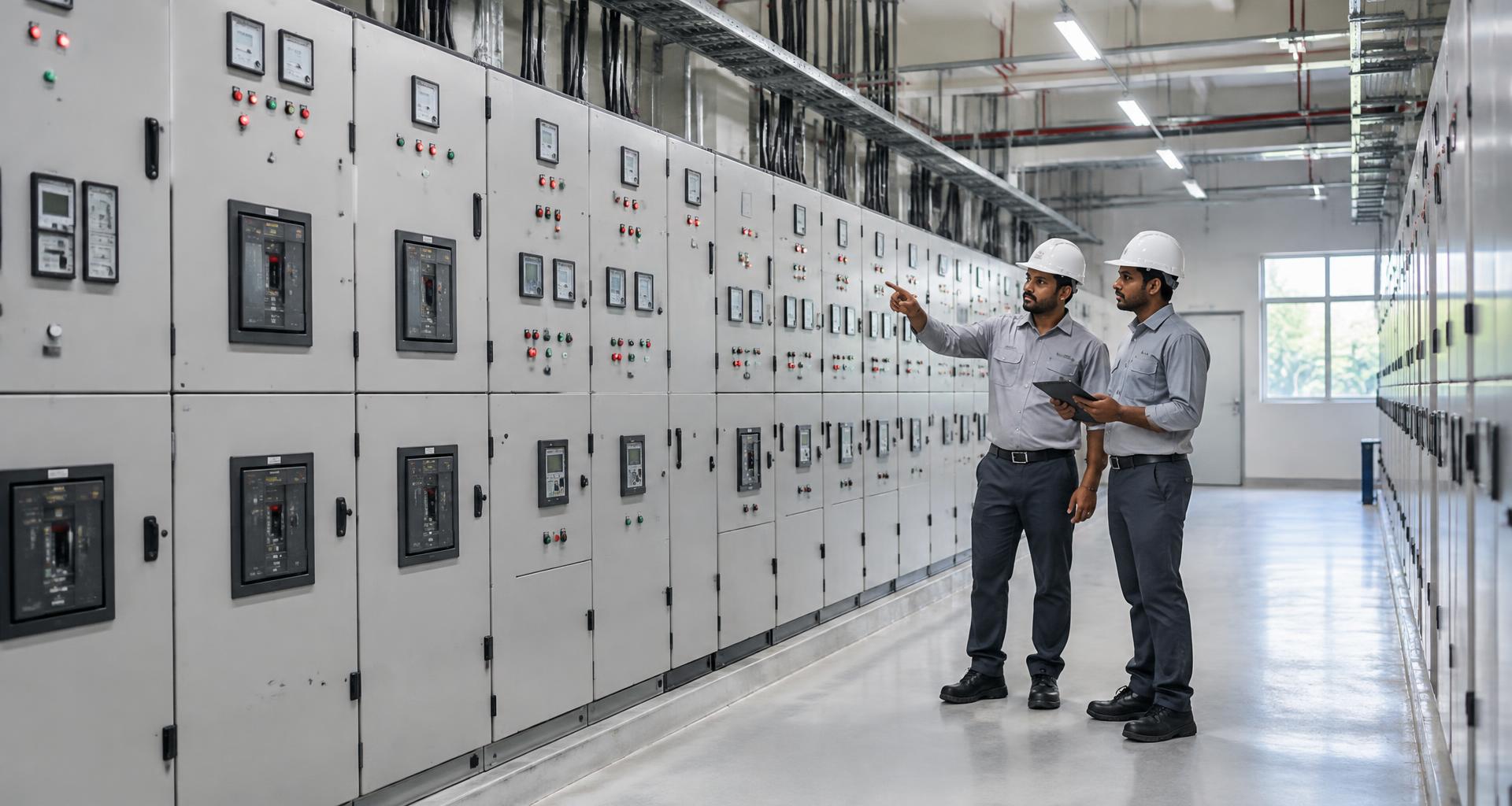
Commercial Building Energy Audit & Cost Reduction Strategies in Bengaluru
Strategic energy audit guide for commercial properties in Bengaluru, detailing ASHRAE Level 1 & 2 methodology, baseline EUI modeling, VFD retrofits, APFC tuning, and financial ROI.

A commercial building energy audit in Bengaluru follows ASHRAE Level 1 & 2 methodologies to establish an Energy Utilization Index (EUI), identify electrical and thermal waste, and execute cost-effective retrofits—including VFDs on pumps, chiller sequencing, and APFC unity power factor tuning. JTechno Associates helps commercial facilities cut energy consumption by 14% to 26% with payback periods under 18 months.
Key Engineering Highlights
- Commercial real estate in Bengaluru averages an Energy Utilization Index (EUI) of 140 to 220 kWh/sq.ft/year; audits identify pathways to reach < 110 kWh/sq.ft/year.
- HVAC chiller plants and pumping systems represent 55% to 65% of total commercial building energy consumption, offering the highest retrofit ROI.
- Maintaining an average monthly power factor > 0.99 using automatic APFC panels earns BESCOM utility tariff incentives while eliminating kVAh billing penalties.
- Variable Frequency Drive (VFD) retrofits on primary/secondary chilled water pumps yield 25% to 40% electrical energy savings through Affinity Law speed modulation.
- Energy Conservation Measures (ECMs) are categorized into low-cost operational tuning, medium-cost equipment retrofits, and high-impact capital upgrades.
The Business Imperative of Energy Optimization in Bengaluru Commercial Real Estate
In Bengaluru's competitive commercial real estate landscape—spanning tech parks in Whitefield and the Outer Ring Road (ORR) to prime corporate towers in the Central Business District (CBD)—electricity bills represent the single largest variable operating expenditure for property developers and corporate occupiers. Commercial electricity tariffs from Bangalore Electricity Supply Company (BESCOM), combined with high diesel generation costs, create an urgent imperative to eliminate electrical and thermal waste.
Moreover, global institutional investors and Fortune 500 tenants increasingly require buildings to hold recognized green building certifications (such as LEED Platinum, IGBC, or BEE Energy Star). Achieving these sustainability benchmarks requires moving beyond superficial measures toward an engineering-grade energy audit that quantifies baseline consumption, identifies operational anomalies, and prioritizes retrofits through rigorous financial modeling.
ASHRAE Level 1 & Level 2 Energy Audit Methodology
JTechno Associates conducts commercial building energy audits following international ASHRAE standards. An ASHRAE Level 1 (Walk-Through Analysis) establishes baseline building energy consumption by analyzing 24 to 36 months of utility bills, calculating the Energy Utilization Index (EUI in kWh/sq.ft/year), and conducting preliminary site inspections to identify obvious operational waste (such as uninsulated pipes, running pumps with closed valves, and outdated lighting).
An ASHRAE Level 2 (Energy Survey and Engineering Analysis) performs detailed diagnostic measurement: deploying portable power quality analyzers to record electrical load profiles across substations and chillers, logging thermodynamic delta-T parameters across chilled water circuits, evaluating cooling tower heat rejection efficiency, and auditing air handling unit static pressures. The resulting audit report quantifies Energy Conservation Measures (ECMs) with precise capital expenditure (CAPEX) estimates, annual operational savings, and Simple Payback Periods (SPP).
- Calculate baseline Energy Utilization Index (EUI) and compare against regional IT park benchmarks.
- Install data loggers across main incoming transformers and chiller feeders for 7-day load profiling.
- Measure chiller COP and kW/TR across varying partial load conditions (50%, 75%, 100%).
- Audit APFC capacitor bank steps to verify automatic unity power factor (PF > 0.99) maintenance.
- Evaluate airside economizer and night-purge ventilation feasibility using psychrometric charts.
Chiller Plant Optimization: Variable Primary Flow (VPF) & Water Loop Balancing
Because HVAC systems account for over half of total building energy consumption, central chiller plant optimization delivers the most substantial financial returns. Legacy plants frequently operate constant-speed primary pumps paired with secondary distribution pumps, circulating massive water volumes regardless of tenant cooling demand.
Converting legacy pumping systems to Variable Primary Flow (VPF) using Variable Frequency Drives (VFDs) on all pumps allows the system to modulate water flow according to real-time cooling loads. Under the centrifugal Affinity Laws, pump power consumption is proportional to the cube of rotational speed: reducing pump speed by just 20% slashes electrical power draw by nearly 50%. Combined with automated condenser tube brushing to eliminate thermal scaling, chiller plant energy intensity can be reduced from 0.85 kW/TR down to 0.62 kW/TR.
Power Factor Correction (APFC) & BESCOM Billing Optimization
Under Karnataka Electricity Regulatory Commission (KERC) commercial tariff structures, BESCOM bills commercial and industrial consumers on apparent energy (kVAh) rather than real energy (kWh). If a commercial facility operates with a low power factor (e.g. 0.88 PF caused by uncompensated inductive motors), the facility is billed for 14% more energy than it actually consumes.
JTechno Associates audits and tunes Automatic Power Factor Correction (APFC) panels equipped with detuned reactors (typically 7% or 14% reactors) to prevent harmonic resonance. By maintaining an average monthly power factor above 0.99, facilities avoid thousands of rupees in kVAh penalties and earn statutory power factor rebate incentives directly credited on their monthly BESCOM electricity bills.
Smart Lighting Controls & Occupancy Integration
While lighting retrofits to high-efficiency LEDs (delivering > 130 lumens/watt) have become standard, significant energy savings remain unlocked through intelligent controls. In many corporate offices, perimeter zones receive abundant natural daylight, yet perimeter luminaires remain energized at full brightness throughout the day.
Integrating daylight harvesting photo-sensors with DALI-2 dimmable LED drivers modulates artificial lighting output based on natural ambient illumination. Pairing daylight harvesting with microwave occupancy sensors in conference rooms, restrooms, and corridors cuts interior lighting energy by an additional 25% to 35% without impacting occupant comfort.
Financial Modeling & Lifecycle Cost Analysis (LCCA) for Real Estate Boards
The ultimate success of an energy audit lies in translating technical engineering recommendations into compelling business cases for corporate executive boards. Every Energy Conservation Measure (ECM) proposed by JTechno Associates is modeled using standard capital budgeting metrics: Simple Payback Period (SPP), Net Present Value (NPV), and Internal Rate of Return (IRR).
Recommendations are organized into three tiers: Tier 1 (Low-cost operational optimizations, such as re-tuning chiller setpoints and fixing Low Delta-T valves, delivering payback in < 3 months); Tier 2 (Medium-cost retrofits, such as VFD installations and APFC capacitor upgrades, delivering payback in 9 to 18 months); and Tier 3 (High-impact capital upgrades, such as magnetic-bearing chiller retrofits, delivering payback in 2.5 to 4 years).
| Energy Conservation Measure (ECM) | Target Subsystem | Estimated Energy Savings | Typical Payback Period |
|---|---|---|---|
| Chilled Water Temperature Reset | Central Chiller Plant | 3% – 5% of chiller kWh | Immediate (< 1 month) |
| APFC Tuning & Capacitor Upgrade | Electrical Substation LT | Eliminate kVAh penalty + 0.5% rebate | 2 – 4 Months |
| Low Delta-T Valve Rebalancing | Secondary Chilled Water | 8% – 12% of pump energy | 3 – 6 Months |
| VFD Retrofits on Chilled Water Pumps | Primary / Secondary Pumps | 25% – 40% of pumping kWh | 10 – 14 Months |
| Cooling Tower Fan VFD & Wet Bulb Tuning | Heat Rejection Loop | 15% – 25% of tower kWh | 8 – 12 Months |
| Daylight Harvesting & LED Dimming | Tenant Floor Lighting | 20% – 35% of lighting kWh | 12 – 18 Months |
| Magnetic-Bearing Oil-Free Chiller Upgrade | Central Chiller Plant | 22% – 32% total HVAC kWh | 30 – 42 Months |
Frequently Asked Technical Questions
What is an Energy Utilization Index (EUI) and what is the benchmark for IT parks in Bengaluru?
The Energy Utilization Index (EUI) measures total annual energy consumption divided by gross floor area (expressed as kWh/sq.ft/year). For air-conditioned IT parks in Bengaluru, standard commercial buildings average 140 to 220 kWh/sq.ft/year, while high-performance green-certified facilities achieve EUIs below 110 kWh/sq.ft/year.
How does BESCOM's kVAh billing penalize facilities with low power factor?
In kVAh billing, the utility charges for apparent power (kVAh = kWh / Power Factor). If a facility operates at 0.85 PF, it registers 1.17 kVAh for every 1.0 kWh consumed, effectively paying a 17.6% premium on energy charges. Maintaining unity power factor (1.0 PF) eliminates this entire surcharge.
What is the difference between an ASHRAE Level 1 and Level 2 energy audit?
An ASHRAE Level 1 audit is a preliminary walk-through and utility bill analysis that identifies obvious energy waste and rough savings opportunities. A Level 2 audit involves in-depth instrumentation measurement, electrical logging, thermodynamic calculations, and detailed financial modeling for every energy conservation measure.
Why should variable frequency drives (VFDs) have harmonic detuned reactors?
VFDs generate harmonic currents that can distort the building electrical waveform. Installing line reactors or detuned filters prevents these harmonics from causing capacitor overheating, transformer noise, and resonance that can trip sensitive upstream switchgear.
What is the typical return on investment (ROI) for an energy audit in commercial properties?
Commercial properties implementing Tier-1 and Tier-2 energy conservation measures typically achieve a 14% to 26% reduction in overall electricity consumption, delivering full payback on audit and implementation costs within 9 to 18 months.
Related Critical Facility Management Services
Central HVAC Chiller Plant O&M
Primary/secondary chilled water optimization, VFD retrofits, and condenser descaling.
Building Management Systems (BMS)
Automated energy monitoring dashboards, demand-controlled ventilation, and chiller staging.
Electrical Substation Maintenance
APFC capacitor bank maintenance, power factor tuning, and harmonic mitigation.
Electrical Safety Audits
Pairing energy reduction with statutory CEIG compliance and thermographic hazard mitigation.
Engineering standards and operational procedures referenced herein comply with Central Electricity Authority (CEA), CEIG Karnataka, Central Pollution Control Board (CPCB), ASHRAE, and National Building Code (NBC 2016) specifications. Facility assessments by JTechno Associates determine site-specific maintenance scopes for commercial properties across Karnataka.
Ready for zero-surprise uptime?
Start with a conversation. We’ll take it from there.