
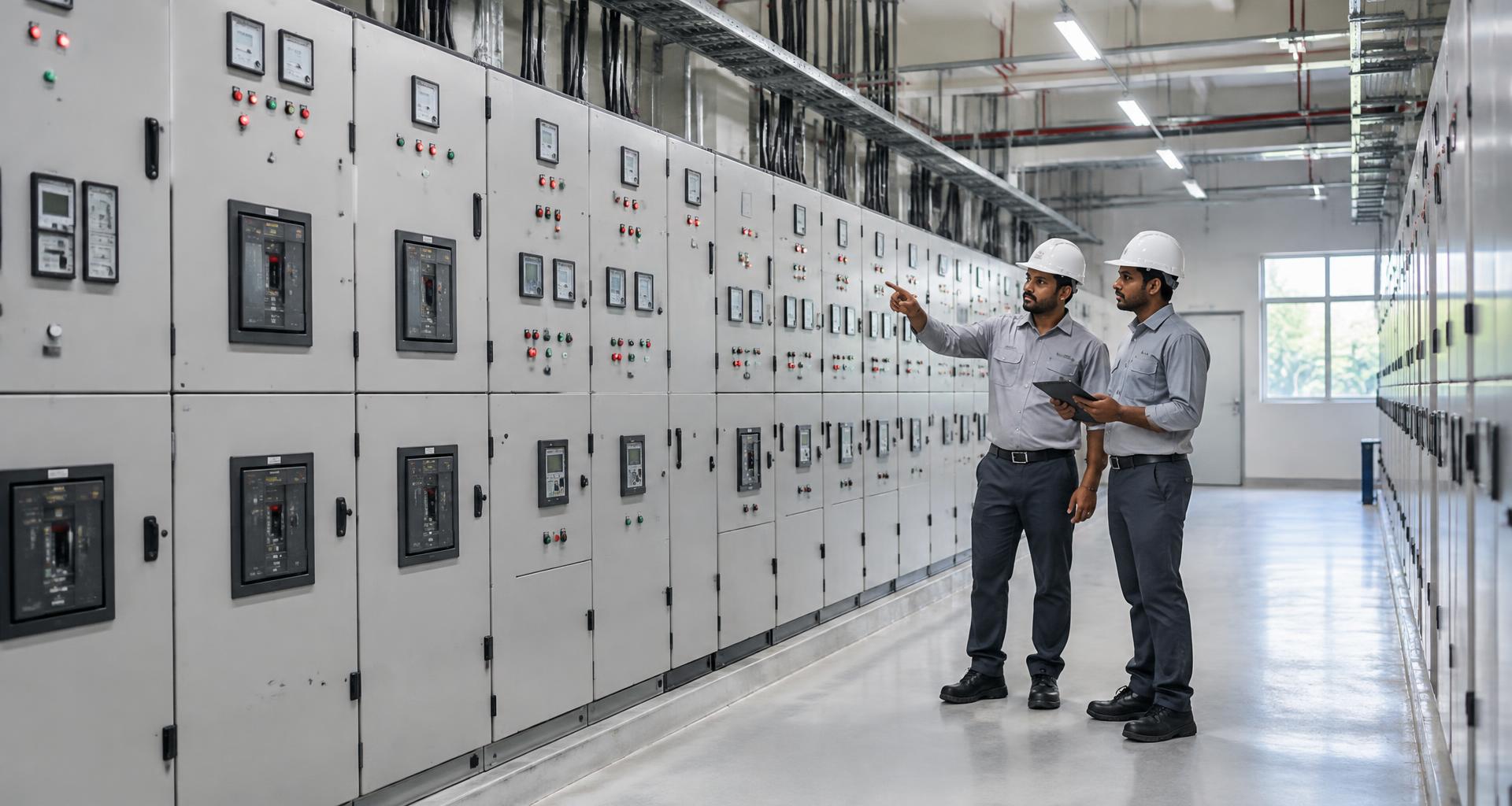
Building Management System (BMS) Automation & Preventive Maintenance Guide
Technical engineering guide on BMS automation maintenance, DDC controller calibration, BACnet/Modbus integration, and energy-saving chiller sequencing in Bengaluru smart buildings.

Building Management System (BMS) maintenance for commercial properties in Bengaluru requires regular calibration of Direct Digital Control (DDC) field sensors, verification of open communication protocols (BACnet, Modbus), and tuning of automated chiller sequencing logic. JTechno Associates ensures smart building automation systems deliver 15% to 25% utility energy reductions while eliminating nuisance alarms and sensor drift.
Key Engineering Highlights
- Field sensor drift (temperature, relative humidity, CO2, differential pressure) is the root cause of HVAC overcooling and energy waste.
- Direct Digital Control (DDC) panels require routine battery backup verification and flash memory firmware integrity audits.
- Standardizing on open communication protocols like BACnet MS/TP and Modbus TCP prevents proprietary vendor lock-in during system expansions.
- Automated enthalpy-based economizer cycles and night purge ventilation significantly reduce daytime chiller cooling loads in Bengaluru's moderate climate.
- Alarm rationalization frameworks eliminate operator alarm fatigue by distinguishing critical mechanical trips from informational warnings.
The Critical Role of BMS in High-Performance Bengaluru Tech Campuses
Modern corporate towers and IT development centers across Bengaluru's tech clusters—including Whitefield, Bellandur, and Hebbal—rely on advanced Building Management Systems (BMS) and Building Automation Systems (BAS) to control thousands of interconnected electro-mechanical points. An intelligent BMS serves as the central nervous system of a commercial facility, coordinating HVAC chillers, air handling units, variable air volume (VAV) boxes, lighting circuits, diesel generators, and water distribution networks.
However, a BMS is only as reliable as its field sensors, network controllers, and programmed control logic. Without disciplined preventive maintenance, building automation systems degrade quickly into 'dumb' manual override states. Studies across commercial real estate portfolios indicate that over 60% of commercial buildings operate with overridden control loops, resulting in simultaneous heating and cooling, premature equipment wear, and escalating utility bills.
DDC Controllers, Field Sensors & Actuator Calibration Protocols
Direct Digital Control (DDC) panels distributed across facility electrical shafts interface directly with field instrumentation. Environmental and thermodynamic sensors—including duct temperature sensors, chilled water immersion thermowells, relative humidity sensors, indoor CO2 transmitters, and water differential pressure transducers—are prone to calibration drift caused by airborne dust, thermal cycling, and electrical noise.
Preventive maintenance protocols mandate bi-annual calibration of critical analog sensors using certified reference instruments (such as precision dry-block temperature calibrators and digital hand-held manometers). A temperature sensor reading just 1.5°C lower than actual conditions will drive an air handling unit to supply excess cooling air, dramatically increasing chiller plant power consumption. In addition, modulating valve actuators (0–10V or 4–20mA) must be physically inspected to verify smooth stroke travel from 0% (fully closed) to 100% (fully open) without mechanical backlash or hunting.
- Calibrate chilled water temperature immersion sensors against certified reference thermometers.
- Check DDC controller internal battery backups and log memory utilization metrics.
- Inspect motorized modulating damper actuators for full mechanical travel and feedback accuracy.
- Clean and zero-calibrate differential pressure transducers across AHU filter banks.
- Audit indoor air quality (IAQ) CO2 sensors in occupied floor zones against calibrated reference gases.
BACnet, Modbus & LonWorks Open Protocol Architecture Integration
Enterprise commercial buildings inevitably integrate equipment from diverse manufacturers: chillers from Carrier or Trane, VFDs from Danfoss or ABB, electrical energy meters from Schneider, and fire alarm panels from Honeywell or Siemens. Seamless inter-operability depends on robust open communication protocols, predominantly BACnet MS/TP (EIA-485 serial), BACnet/IP (Ethernet), and Modbus RTU/TCP.
Maintenance engineers must routinely monitor network health: scanning for communication packet drops, token-passing delays, and bus termination resistance integrity (verifying 120-ohm end-of-line resistors). When expanding tenant fit-outs, maintenance teams ensure new third-party gateways adhere to standard BACnet object naming conventions, preventing communication bottlenecks that could freeze supervisory operator workstations.
Energy Optimization Control Algorithms: Sequencing & Economizer Cycles
A properly tuned BMS actively minimizes energy consumption through automated control algorithms. In central chiller plants, automated staging and de-staging logic balances running chillers at their optimal efficiency sweet-spot (typically 65% to 80% part-load ratio) rather than allowing a single machine to operate at inefficient 95% full load while another runs at 25% load.
Furthermore, taking advantage of Bengaluru's moderate nocturnal and early-morning climate, smart BMS systems execute 'Night Purge' ventilation. Outside air dampers open fully during pre-dawn hours to flush warm indoor air with cool ambient air, pre-cooling the building concrete thermal mass before employees arrive. During daytime operation, Demand-Controlled Ventilation (DCV) modulates fresh air intake based on real-time zone CO2 concentrations (maintaining < 800 ppm), avoiding the energy penalty of conditioning unnecessary outside air during partial occupancy.
Predictive Fault Detection and Diagnostics (FDD) & Alarm Management
Next-generation facility management shifts from reactive alarm response to automated Fault Detection and Diagnostics (FDD). Advanced BMS software applies mathematical rules to detect subtle mechanical degradation: identifying an AHU cooling coil valve that is leaking chilled water when the fan is stopped, or a variable-flow pump that is hunting due to improperly tuned PID loop gains.
Alarm management is equally critical. In many poorly maintained buildings, operator consoles are flooded with thousands of nuisance alarms daily, causing operators to mute warning sounders. JTechno Associates implements alarm rationalization frameworks: auditing alarm limits, implementing deadbands, suppressing cascading secondary alarms, and categorizing alarms into Critical (immediate life/equipment hazard), Warning (preventive action required within 2 hours), and Informational.
BMS Database Hygiene, Cybersecurity & Disaster Recovery
As building automation systems become increasingly connected to corporate IT networks and cloud telemetry platforms, they become potential targets for cybersecurity breaches. Maintenance protocols mandate isolating BMS OT (Operational Technology) networks on dedicated VLANs with strict firewall rules and disabled default administrative passwords.
Routine maintenance includes weekly automated backups of supervisory server databases, DDC controller firmware configurations, and historical trending archives. In the event of a controller hardware failure, technicians can flash the stored program into a replacement controller within 30 minutes, restoring full automatic building operation without manual intervention.
| Automation Subsystem | Maintenance / Calibration Protocol | Target Standard / Tolerance | Frequency |
|---|---|---|---|
| Temperature Sensors | Immersion & duct sensor calibration | Accuracy within ±0.2°C of reference | Bi-Annual |
| Modulating Actuators | Stroke travel & position feedback check | Full 0–100% travel; zero hunting | Quarterly Audit |
| DDC Controllers | CPU load, memory, battery backup test | CPU < 60%, Battery > 3.0V DC | Quarterly Check |
| Communication Bus | BACnet MS/TP packet drop & token check | Packet error rate < 0.1%; 120Ω EOL | Monthly Network Scan |
| CO2 & IAQ Transmitters | Multi-point calibration with test gas | Reading within ±50 ppm of standard | Bi-Annual |
| Software & Database | System image backup & trend archiving | Complete server image on secure NAS | Weekly Automated |
Frequently Asked Technical Questions
Why do field sensors on a BMS drift over time?
Field sensors drift due to environmental exposure, dust accumulation on sensing elements, thermal expansion cycles, and aging of internal electronic components. Temperature and humidity sensors typically drift by 0.2°C to 0.5°C annually, necessitating periodic recalibration against laboratory-certified reference standards.
What is the difference between BACnet and Modbus in commercial building automation?
BACnet is an object-oriented protocol specifically engineered for building automation, featuring automated device discovery, standard object naming, and complex scheduling services. Modbus is a simpler, register-based industrial protocol widely used for interfacing electrical power meters, VFDs, and generators into the central BMS.
How does Demand-Controlled Ventilation (DCV) save energy in office buildings?
DCV uses real-time indoor CO2 sensors to modulate fresh air intake dampers. Instead of continuously conditioning a fixed volume of hot, humid outside air, the BMS brings in only the fresh air required for the actual number of occupants on the floor, reducing cooling energy by 15% to 30%.
What happens when a DDC controller loses communication with the central BMS server?
Properly programmed DDC controllers operate autonomously. Even if the central supervisory server or network switch goes offline, the local DDC controller continues executing its programmed PID loops, safety interlocks, and local scheduling without interruption.
How does alarm rationalization improve building safety?
Alarm rationalization filters out nuisance and redundant alarms, ensuring control room operators are not overwhelmed by thousands of trivial notifications. This allows operators to immediately identify and respond to genuine high-priority equipment trips or life-safety events.
Related Critical Facility Management Services
Building Management Systems (BMS)
Intelligent building automation, DDC maintenance, sensor calibration, and energy analytics.
Central HVAC Chiller Plant O&M
Integrating chiller plant sequencing and cooling tower automation with the central BMS.
Electrical Substation Maintenance
Power quality telemetry, transformer temperature monitoring, and breaker status integration.
Commercial Energy Audits
Leveraging historical BMS trend data to identify baseline energy waste and operational anomalies.
Engineering standards and operational procedures referenced herein comply with Central Electricity Authority (CEA), CEIG Karnataka, Central Pollution Control Board (CPCB), ASHRAE, and National Building Code (NBC 2016) specifications. Facility assessments by JTechno Associates determine site-specific maintenance scopes for commercial properties across Karnataka.
Ready for zero-surprise uptime?
Start with a conversation. We’ll take it from there.