
How to Choose an Integrated Facility Management Company in Bengaluru: Technical Due Diligence Guide
A comprehensive technical evaluation framework for corporate real estate directors and procurement committees selecting an integrated facility management partner across Bengaluru's high-tech commercial corridors.

Choosing an integrated facility management (IFM) partner in Bengaluru requires rigorous technical due diligence beyond pricing proposals. Key evaluation criteria include verifying SuperGrade or Class-A electrical contractor licensing from the Karnataka Electrical Licensing Board, certified technical staffing capabilities (HVAC, BMS, HT substations), automated computerized maintenance management system (CMMS) reporting, 100% statutory labor compliance (ESI/PF), and verified client track records across enterprise campuses.
Key Engineering Highlights
- Verify legal engineering licensing: only firms holding a SuperGrade Electrical Contractor License can legally service high-tension commercial substations in Karnataka.
- Distinguish between hard technical maintenance capabilities (electrical, HVAC, DG, STP) and soft housekeeping services.
- Inspect statutory compliance documentation: demand certified challans for ESI, EPF, and professional tax remittances for the previous 24 months.
- Evaluate technician retention rates and training infrastructure: high turnover directly degrades on-site equipment safety and uptime.
- Mandate transparent CMMS telemetry and digital shift logs over manual paper binders to maintain real-time operational visibility.
The Technical vs. Soft Facility Management Distinction
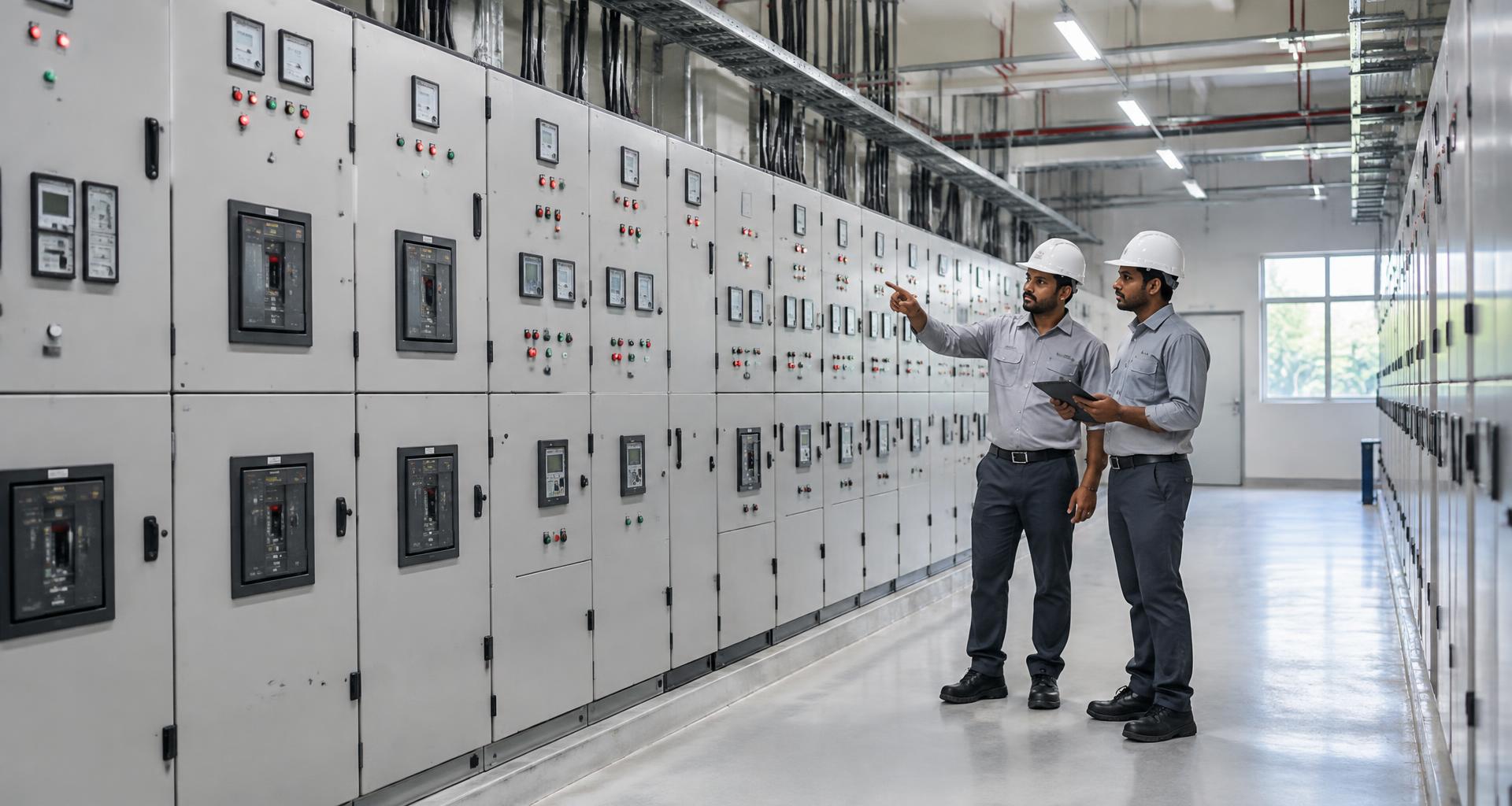
Many commercial property owners make the mistake of hiring generalist facility vendors whose core background is soft services (janitorial cleaning, landscape grooming, security guarding). While soft services are vital for property aesthetics, they do not prepare a vendor to operate an 11kV substation, synchronize 2,000 kVA generators, descaling centrifugal chillers, or remediate biological washouts in an STP.
In mission-critical tech environments like Bengaluru, hard electro-mechanical engineering must be led by an engineering-first contractor. The selected partner must possess internal technical expertise capable of troubleshooting micro-processor relays, measuring power harmonics, and executing chiller condenser approach temperature calculations without relying on unvetted third-party subcontractors.
The 12-Point Technical Due Diligence Checklist
Before awarding a multi-year facility management contract, procurement committees should score prospective vendors against this twelve-point operational scorecard:
Statutory Labor Compliance & Financial Due Diligence
Under Indian labour jurisprudence, the principal employer remains jointly liable for unpaid statutory dues of contract labour deployed on their premises. A compliant facility partner must furnish proof of dedicated PF sub-codes, individual employee ESI registration numbers, and prompt monthly remittance receipts.
Vendors offering cut-rate bids below statutory minimum wages inevitably practice compliance corner-cutting, employee underpayment, or ghost staffing—exposing building owners to labour department notices and sudden contractor walk-outs.
Transition Management: The 60-Day Mobilization Framework
The greatest operational risk in facility management occurs during the transition window between the incumbent vendor and the incoming service partner. An experienced contractor deploys a dedicated mobilization team 30 to 45 days prior to go-live.
During this phase, technical engineers conduct joint snag audits of all critical assets (substations, chillers, DGs, fire pumps), map equipment tagging, establish baseline operational readings, and verify spare parts inventories to prevent inherited equipment liabilities.
Frequently Asked Technical Questions
Why is a SuperGrade electrical license critical for an FM vendor in Karnataka?
Under Karnataka statutory regulations, only contractors holding a SuperGrade Electrical Contractor License issued by the Karnataka Electrical Licensing Board are legally authorized to operate, maintain, and certify high-tension electrical installations above 650V.
How long should a facility management transition take?
A structured facility handover typically requires 30 to 60 days. This allows adequate time for joint asset condition surveys, technical recruitment, safety inductions, and SOP customization.
What is an acceptable technician-to-area ratio in commercial buildings?
Staffing density depends on the density of installed electro-mechanical assets rather than square footage alone. A typical commercial tech park requires one multi-skilled technician per 40,000 to 60,000 sq. ft., supported by dedicated substation and central chiller operators.
Can JTechno Associates manage facility transitions from existing vendors?
Yes. JTechno Associates provides full turnkey transition management, executing detailed equipment condition audits, staff shadowing, and risk mitigations to ensure uninterrupted 24/7 facility operations.
Engineering standards and operational procedures referenced herein comply with Central Electricity Authority (CEA), CEIG Karnataka, Central Pollution Control Board (CPCB), ASHRAE, and National Building Code (NBC 2016) specifications. Facility assessments by JTechno Associates determine site-specific maintenance scopes for commercial properties across Karnataka.
Ready for zero-surprise uptime?
Start with a conversation. We’ll take it from there.