
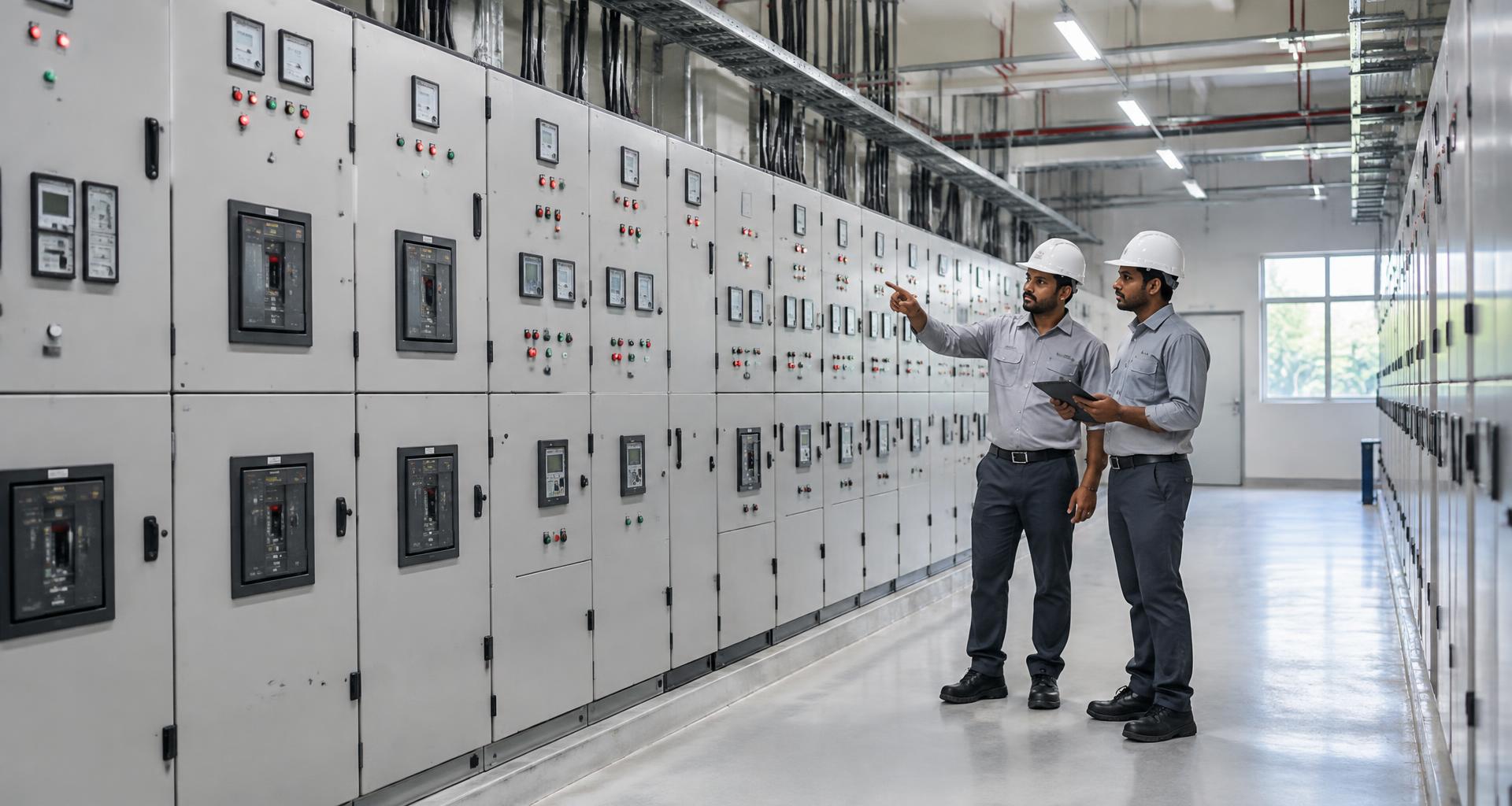
Electrical Substation Operation & Maintenance Guide for Commercial Facilities in Bengaluru
Comprehensive engineering manual covering HT/LT transformer maintenance, VCB testing, oil BDV tests, CEIG statutory compliance, and emergency busbar isolation protocols in Bengaluru.

Electrical substation operation and maintenance (O&M) for commercial facilities in Bengaluru requires scheduled preventive servicing of 11kV/33kV transformers, vacuum circuit breakers (VCBs), protection relays, and busducts under CEIG statutory guidelines. JTechno Associates provides round-the-clock licensed engineering teams ensuring zero unscheduled power disruptions and full statutory compliance across Karnataka tech corridors.
Key Engineering Highlights
- Transformer dielectric oil must maintain a Breakdown Voltage (BDV) > 50 kV to prevent catastrophic insulation failure.
- Chief Electrical Inspector to Government (CEIG) Karnataka safety inspections require annual calibrated relay logs and earth pit test records.
- Quarterly contact resistance and timing tests on 11kV/33kV Vacuum Circuit Breakers (VCBs) prevent arcing damage during fault trips.
- Thermographic infrared scanning of HT cable terminations and busduct joints isolates thermal hotspots before phase-to-phase flashovers occur.
- 24/7 shift deployment of Class-A licensed electrical supervisors is legally required for high-tension consumer installations in Karnataka.
Mission-Critical Substation Architecture in Bengaluru Commercial Tech Corridors
Commercial real estate assets across Bengaluru's prominent IT hubs—including Whitefield, Electronic City, and the Outer Ring Road (ORR)—rely on dedicated 11kV, 33kV, or 66kV indoor and outdoor substations to step down utility grid power from Bangalore Electricity Supply Company (BESCOM) to standard 415V three-phase distribution voltages. A single hour of unmanaged substation downtime can cripple enterprise data halls, disrupt global development centers, and trigger millions of rupees in direct productivity losses.
Operating high-tension electrical infrastructure demands rigorous operational discipline. Substations are not static utility rooms; they are dynamic electro-mechanical ecosystems operating under fluctuating ambient temperatures, harmonic pollution generated by non-linear IT loads, and severe grid voltage transients. Sustainable operation requires a preventive, condition-based maintenance framework executed by licensed electrical engineers who thoroughly understand Central Electricity Authority (CEA) safety guidelines and Karnataka statutory mandates.
HT/LT Transformer Preventative Maintenance Protocols (BDV, DGA & Winding Resistance)
The power transformer is the heart of any commercial substation. Whether operating dry-type cast resin units within basement substations or outdoor oil-immersed ONAN transformers, comprehensive maintenance begins with routine insulation resistance and fluid dielectric testing. For oil-filled transformers, oil samples must undergo Breakdown Voltage (BDV) testing every six months. A healthy oil sample must withstand a minimum dielectric threshold of 50 kV across standard 2.5 mm electrode gaps; values below 40 kV indicate moisture contamination or particulate sludge requiring immediate filtration or dehydration.
For high-capacity installations (transformers rated 1.5 MVA and above), annual Dissolved Gas Analysis (DGA) using gas chromatography detects early-stage thermal faults and electrical arcing. The presence of elevated acetylene (C2H2) signals high-energy arcing, while elevated ethylene (C2H4) and methane (CH4) indicate overheating in winding insulation. In addition, physical inspection must verify that silica gel breathers remain cobalt blue (deep pink indicates saturation requiring replacement), explosion relief diaphragms remain intact, and Buchholz relays trigger alarm and trip signals under calibrated pneumatic test injections.
- Measure transformer oil dielectric Breakdown Voltage (BDV); threshold > 50 kV.
- Inspect silica gel breather condition; regenerate or replace when 50% turns pink.
- Execute winding insulation resistance (Megger test) at 2.5 kV for HT and 1 kV for LT windings.
- Verify oil temperature indicator (OTI) and winding temperature indicator (WTI) trip setpoints (90°C alarm / 105°C trip).
- Inspect neutral grounding and body earth connections for zero oxidation and < 1.0 Ohm resistance.
Switchgear & Vacuum Circuit Breaker (VCB) Testing Procedures
Medium-voltage switchgear panels housing 11kV or 33kV Vacuum Circuit Breakers (VCBs) and SF6 breakers protect substation infrastructure against downstream short circuits and grid surges. Contact erosion, mechanical binding in spring-charging mechanisms, and vacuum bottle degradation represent the primary failure modes in commercial switchgear.
During scheduled quarterly shutdowns, technical maintenance crews must measure contact resistance across all three phases using a 100A micro-ohmmeter. Contact resistance must remain within OEM limits (typically < 30 micro-ohms); elevated readings signify pitted contact surfaces that will cause localized overheating under full load. Breaker opening and closing times must be measured using digital timing kits to confirm concurrent pole operation within 3 milliseconds. Stored-energy spring charging motors, anti-pumping relays, and trip-free mechanisms require routine mechanical lubrication using synthetic dielectric grease.
Numerical Protection Relay Calibration & Tripping Tests
Modern commercial substations employ numerical micro-processor relays to execute overcurrent (50/51), earth fault (50N/51N), under/overvoltage (27/59), and differential protection (87T). Relying on an uncalibrated protection relay is equivalent to operating without protection; an uncleared downstream fault can backfeed into the main utility supply, resulting in catastrophic equipment destruction and BESCOM grid disconnection.
Relay testing requires secondary current injection using calibrated test kits (such as Omicron or Doble units) to verify pick-up currents, operating curves (IDMT normal inverse), and instantaneous trip timing. The auxiliary DC supply—typically a 110V or 220V lead-acid or nickel-cadmium battery bank that powers the trip coils—must undergo quarterly discharge capacity testing. A failure in the DC tripping circuit means that when a fault occurs, the breaker will not open, forcing upstream grid trip protection.
CEIG Karnataka Statutory Inspection Readiness & Compliance Framework
In Karnataka, the Department of Electrical Inspectorate (CEIG) regulates the safety, installation, and operation of high-tension consumer installations under the Central Electricity Authority (Measures Relating to Safety and Electric Supply) Regulations, 2010. Every commercial consumer operating an HT connection must renew their annual CEIG safety approval.
CEIG inspection readiness requires complete maintenance documentation: valid calibration certificates for all protection relays, transformer oil test certificates from NABL-accredited laboratories, quarterly earth resistance test logbooks signed by a licensed Class-1 Electrical Contractor, and updated single-line diagrams (SLD) displayed in the control room. JTechno Associates manages the complete compliance lifecycle, ensuring zero statutory penalties, zero shutdown notices, and rapid resolution of inspectorate observations.
Emergency Shutdown & Busbar Isolation Protocols
When an electrical fire, gas release, or insulation flashover occurs, substation operators must execute rapid emergency shutdown protocols without endangering human life. Operating personnel must follow strict Tagout-Lockout (LOTO) procedures: verify busbar isolation using non-contact HT voltage detectors, rack out the incoming vacuum circuit breaker, discharge residual electrostatic capacitance to ground using portable earthing leads, and lock the switchgear shutters.
JTechno Associates conducts quarterly simulated emergency drills for on-site facility personnel across Bengaluru campuses. These drills ensure that shift technicians can isolate damaged bus sections, transfer critical loads to emergency standby diesel generators within 60 seconds, and coordinate safe clearance with BESCOM authorities.
| Equipment / Subsystem | Maintenance Activity | Benchmark / Tolerance | Recommended Frequency |
|---|---|---|---|
| Power Transformer Oil | Breakdown Voltage (BDV) & DGA | BDV > 50 kV, Moisture < 20 ppm | Bi-Annual / Annual |
| Cast Resin Dry Transformer | Winding Thermography & Torque | Temp < 115°C, Tighten to OEM Spec | Monthly / Quarterly |
| 11kV Vacuum Circuit Breaker | Contact Resistance & Timing | Resistance < 30 µΩ, Delta < 3 ms | Quarterly Shutdown |
| Protection Relays | Secondary Current Injection | Trip time within ±5% of IDMT curve | Annual (CEIG mandatory) |
| Substation Earth Grid | Fall-of-Potential Resistance Test | Grid < 1.0 Ω, Individual Pit < 2.0 Ω | Bi-Annual (Pre/Post Monsoon) |
| DC Battery Bank (110V) | Cell Voltage & Conductance | Float 2.25V/cell, Specific Grav 1.215 | Monthly Log / Quarterly Test |
| HT Busduct & Cables | Infrared Thermographic Scan | Delta-T between phases < 3°C | Monthly under peak load |
Frequently Asked Technical Questions
What is the minimum acceptable transformer oil BDV for commercial substations in Bengaluru?
Under IS 1866 and CEIG Karnataka guidelines, operating transformer oil must maintain a dielectric breakdown voltage (BDV) of at least 50 kV for 11kV/33kV equipment. Oil testing below 40 kV requires immediate online filtration and dehydration to prevent internal dielectric flashovers.
How frequently must earth pit resistance be measured at an HT substation?
Earth pit resistance must be tested twice a year—once before the monsoon and once after the monsoon. The combined substation earth grid resistance must measure less than 1.0 Ohm, with individual dedicated neutral and body pits measuring under 2.0 Ohms using the calibrated three-point fall-of-potential method.
What statutory certificates does CEIG Karnataka require for annual HT installation approval?
CEIG Karnataka mandates: (1) NABL-accredited transformer oil test reports, (2) Relay calibration certificates signed by a licensed testing agency, (3) Earth resistance test logbook signed by a Class-1 electrical contractor, (4) Updated single-line diagrams, and (5) Proof of deployed licensed supervisors.
Why is infrared thermography critical in commercial substation switchgear maintenance?
Infrared thermography detects thermal anomalies caused by loose busbar bolts, oxidation on breaker finger clusters, and phase load imbalances under live full-load conditions. Catching a 5°C delta-T anomaly prevents insulation degradation and sudden arc-flash incidents.
What is the difference between an indoor dry-type transformer and an oil-cooled unit for IT parks?
Dry-type cast resin transformers are flame-retardant and produce zero toxic emissions, making them ideal for basement installations inside multi-tenant IT towers. Oil-cooled units offer superior outdoor heat dissipation and higher overload tolerances but require dedicated fire-separation walls and oil soak pits.
Related Critical Facility Management Services
Electrical Substation O&M Services
Full-spectrum 24/7 operations, testing, and statutory compliance for commercial HT/LT substations.
Commercial Diesel Generator AMC
Standby power synchronization, CPCB IV+ compliance, and multi-megawatt AMF maintenance.
Commercial UPS Systems & Audits
Precision power quality assurance, battery impedance testing, and static bypass management.
Building Management System Automation
Automated electrical monitoring, power factor telemetry, and intelligent load shedding.
Engineering standards and operational procedures referenced herein comply with Central Electricity Authority (CEA), CEIG Karnataka, Central Pollution Control Board (CPCB), ASHRAE, and National Building Code (NBC 2016) specifications. Facility assessments by JTechno Associates determine site-specific maintenance scopes for commercial properties across Karnataka.
Ready for zero-surprise uptime?
Start with a conversation. We’ll take it from there.