
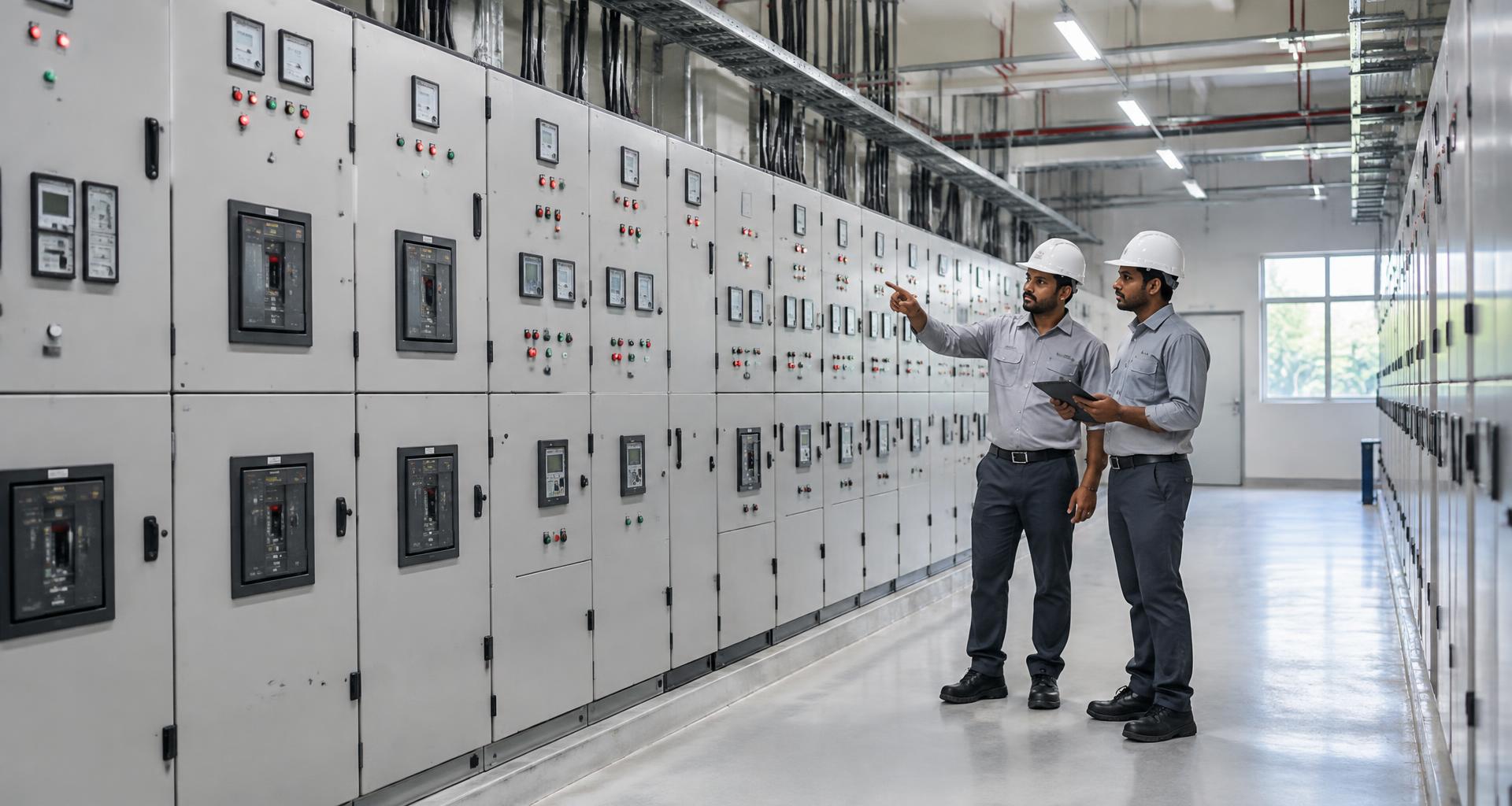
Commercial Electrical O&M Contract Specification Guide: SLA Metrics, Scope & CEIG Compliance
A complete technical specification guide for procurement heads, facility directors, and property managers structuring comprehensive electrical O&M contracts for commercial real estate and IT campuses in Bengaluru.

Structuring an electrical operation and maintenance (O&M) contract for commercial facilities in Bengaluru requires defining clear scopes of work (SOW) across 11kV/33kV substations, internal distribution boards, and backup power plants. Key contract terms must specify 99.98% power availability SLAs, Mean Time to Respond (MTTR) under 15 minutes, licensed technician staffing quotas under Karnataka labour laws, and full contractor liability for statutory CEIG and CEA compliance.
Key Engineering Highlights
- Contracts must separate comprehensive maintenance (labour + parts) from non-comprehensive contracts (labour only with pass-through material spares).
- Power availability SLAs should enforce a minimum threshold of 99.98% across critical technical busbars with liquidated damage penalties for breaches.
- Contractor technical staff must hold valid Karnataka Electrical Licensing Board wireman permits and supervisor competency certificates.
- Statutory compliance audits must verify monthly ESI, PF, professional tax remittances, and workmen compensation insurance policies before invoice clearance.
- Emergency escalation frameworks must establish a 4-tier communication tree linking on-site shift supervisors to the lead technical director.
Scope of Work (SOW) Formulation for Commercial Electrical Contracts
Drafting an effective electrical O&M contract begins with an exhaustive asset inventory. The scope of work must unambiguously delineate the boundary of contractor responsibility—typically starting at the utility metering cubicle (BESCOM interface) down to tenant distribution boards, floor panels, and uninterruptible power supply (UPS) bypass switches.
The SOW should explicitly catalog all routine preventive tasks, frequency schedules (daily, weekly, monthly, quarterly, semi-annually, annually), shutdown testing responsibilities, and emergency breakdown response obligations.
Key SLA Metrics: Availability, Response Times & Power Quality
Commercial tenants in corporate parks and data centers demand stringent service-level guarantees. An SLA model must define measurable performance indicators backed by financial penalties:
1. **Utility Power Availability (>= 99.98%)**: Measures uninterrupted voltage delivery to main distribution panels, excluding utility-side grid blackouts where backup DG synchronization operates successfully.
2. **Mean Time to Respond (MTTR <= 15 minutes)**: On-site engineering staff must initiate physical diagnostic procedures within 15 minutes of an audible trip alarm or telemetry fault notification.
3. **Power Factor Maintenance (Average PF >= 0.990)**: The O&M contractor is held contractually responsible for maintaining APFC bank performance to capture utility rebates and avoid surcharges.
Staffing Qualifications & Statutory Labor Regulations in Karnataka
Electrical maintenance is a legally regulated domain in India. Deploying untrained or uncertified personnel exposes facility owners to criminal liability in the event of an electrical flashover or fatality. Electrical O&M contracts in Bengaluru must mandate that:
All shift electrical supervisors possess a valid Supervisor Competency Certificate issued by the Karnataka Electrical Licensing Board.
All shift electricians and wiremen possess valid Karnataka Wireman Permits with verified safety training in CPR, arc flash protection, and HT switchgear racking.
The service contractor strictly complies with the Contract Labour (Regulation and Abolition) Act, Minimum Wages Act (Karnataka State), Employees' Provident Fund (EPF), Employees' State Insurance (ESI), and mandatory Workmen Compensation insurance policies.
Preventive Shutdown Protocols & Consumable Inventory Management
Major preventive maintenance—including transformer oil dehydration, busbar torque checking, relay secondary injection, and breaker contact resistance tests—requires planned weekend electrical shutdowns. Contracts must stipulate that the service partner submits detailed Standard Operating Procedures (SOPs) and Method of Statements (MOS) at least 14 days prior to any planned outage.
Spare parts management must define a mandatory on-site critical spares inventory: replacement VCB trip coils, auxiliary contact blocks, control fuses, transformer silica gel, dielectric insulating tape, high-rupturing capacity (HRC) fuses, and emergency safety PPE (11kV/33kV insulating rubber gloves and arc-rated face shields).
Frequently Asked Technical Questions
What is the difference between comprehensive and non-comprehensive electrical O&M?
A comprehensive contract includes all technical labour and the cost of replacement spare parts, consumables, and minor repairs. A non-comprehensive contract covers only technical labour and routine testing; replacement spares and major component overhauls are billed separately as pass-through expenses upon client approval.
How are penalty deductions enforced in commercial O&M agreements?
Penalties are calculated monthly against verified performance logs (uptime tracking, power factor invoices, and shift attendance records) and deducted directly from the contractor's monthly gross service invoice.
Who is responsible for CEIG government fees in an electrical O&M contract?
Statutory inspection fees charged by the Karnataka Electrical Inspectorate are typically borne directly by the building owner or reimbursed to the contractor. However, the contractor is entirely responsible for preparing the installation, executing testing, and liaising with inspectors to secure the approval certificate.
Can an electrical O&M contractor also operate backup diesel generators and UPS units?
Yes. Reputable electro-mechanical engineering firms like JTechno Associates provide integrated operational coverage spanning HT substations, diesel generator (DG) plants, and commercial UPS battery systems under one consolidated contract.
Engineering standards and operational procedures referenced herein comply with Central Electricity Authority (CEA), CEIG Karnataka, Central Pollution Control Board (CPCB), ASHRAE, and National Building Code (NBC 2016) specifications. Facility assessments by JTechno Associates determine site-specific maintenance scopes for commercial properties across Karnataka.
Ready for zero-surprise uptime?
Start with a conversation. We’ll take it from there.