
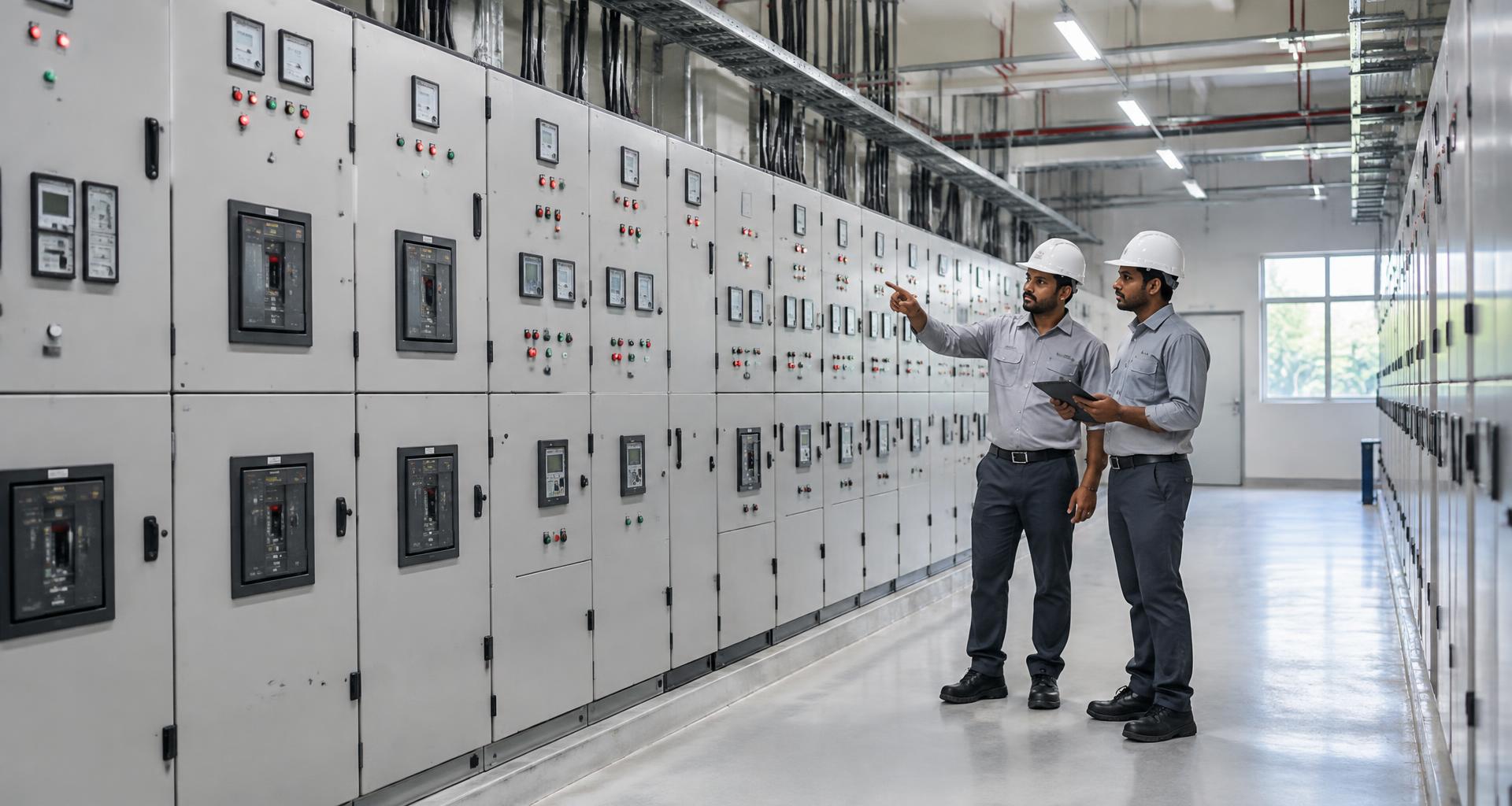
Commercial Electrical Infrastructure O&M: Substations, Transformers & Power Quality Guide
Authoritative engineering guide to commercial electrical infrastructure operations and maintenance in Bengaluru: from 66kV/11kV receiving yards, dry-type and oil-filled transformers, to busducts, harmonic filtration, and statutory CEIG safety compliance.

Commercial electrical infrastructure operations and maintenance (O&M) in Bengaluru requires structured lifecycle maintenance across high-tension (HT) substations, transformer oil filtration, protection relay calibration, and power quality management. Operating under Central Electricity Authority (CEA) regulations and Chief Electrical Inspector to Government (CEIG) Karnataka mandates, facility managers must maintain transformer oil dielectric breakdown voltage above 50 kV, limit total harmonic distortion (THD-I) below 5% per IEEE 519, and retain 24/7 licensed Class-A electrical personnel to ensure zero unscheduled outages.
Key Engineering Highlights
- Substation reliability requires rigorous preventive testing: transformer oil BDV > 50 kV, winding insulation resistance at 2.5 kV, and contact resistance < 30 micro-ohms on vacuum circuit breakers.
- Non-linear IT and VFD loads across Bengaluru tech corridors generate severe 5th and 7th harmonic currents that demand detuned capacitor banks and active harmonic filters.
- Automatic Power Factor Correction (APFC) panels must maintain an average power factor >= 0.992 to capture BESCOM power factor incentives and prevent tariff penalties.
- Chief Electrical Inspectorate to Government of Karnataka (CEIG) mandates annual statutory inspections, Form A filings, and certified earth pit resistance logs under 1.0 Ohm.
- 24/7 technical shift rosters staffed by licensed wiremen and certified electrical supervisors prevent single-point failures in mission-critical facilities.
Commercial High-Tension (HT) Distribution Architecture in Karnataka
Commercial tech parks, enterprise campuses, and data centers across Bengaluru (Electronic City, Whitefield, Bellandur, Outer Ring Road, and Manyata) receive bulk power from Bangalore Electricity Supply Company (BESCOM) at 11kV, 33kV, or 66kV. Stepping down and distributing this high-voltage supply requires an integrated electro-mechanical ecosystem comprising receiving yards, vacuum circuit breakers (VCBs), power transformers, busducts, and motor control centers (MCCs).
Unlike residential networks, commercial IT and corporate facilities operate continuous three-phase loads with heavy inductive and non-linear characteristics. Unplanned downtime can cost millions of rupees per hour in lost productivity, service-level agreement (SLA) penalties, and equipment degradation. A dependable electrical O&M framework combines daily condition monitoring, periodic statutory testing, predictive thermography, and rapid fault isolation protocols.
Transformer Preventive Maintenance: Fluid Dielectrics & Winding Integrity
Whether managing outdoor oil-immersed ONAN/ONAF units or indoor cast-resin dry-type transformers, scheduled maintenance ensures operational longevity and thermal stability. For oil-filled units, moisture and particulate contamination represent the most common threat to dielectric insulation.
Dielectric breakdown voltage (BDV) tests must be performed semi-annually per IS 335. A calibrated oil test cup with standard 2.5 mm spherical electrodes must register breakdown thresholds of at least 50 kV for units in service. If the BDV falls below 40 kV, the transformer oil must undergo high-vacuum centrifugal dehydration and degasification until dielectric strength and moisture levels (< 15 ppm) are restored.
For units rated 1.5 MVA and above, annual Dissolved Gas Analysis (DGA) via gas chromatography identifies thermal overheating and electrical arcing before catastrophic tank rupture occurs. The presence of acetylene (C2H2) indicates high-energy electrical arcing, while elevated ethylene (C2H4) and methane (CH4) reveal localized winding insulation overheating.
Power Quality Engineering: Harmonic Mitigation & APFC Calibration
Non-linear power supplies in corporate server rooms, LED lighting ballasts, and variable frequency drives (VFDs) on HVAC chillers inject large 5th, 7th, 11th, and 13th harmonic currents into the facility's low-tension distribution system. Left unmitigated, high harmonic distortion causes neutral conductor overheating, nuisance circuit breaker tripping, audible transformer hum, and premature capacitor cell failure.
Per IEEE 519-2022 standards, total harmonic distortion for voltage (THD-V) must remain below 5.0%, and total demand distortion for current (TDD-I) must remain below 8.0% at the point of common coupling (PCC). Facility maintenance must implement detuned filter reactors (typically 7% or 5.67% tuning) paired with capacitor banks to prevent harmonic resonance, complemented by active harmonic filters (AHFs) programmed for dynamic reactive current and harmonic cancellation.
Automatic Power Factor Correction (APFC) panels require weekly inspection of micro-processor power factor controllers, detuned reactors, and contactor or thyristor switching modules. Maintaining an operating power factor between 0.992 and unity is critical to earn monthly BESCOM power factor rebate incentives while completely eliminating reactive power penalty surcharges.
CEIG Karnataka Statutory Inspections & Safety Compliance
In Karnataka, high-tension electrical installations are governed by the Chief Electrical Inspector to Government (CEIG) under Central Electricity Authority (Safety Requirements for Operation and Maintenance of Electrical Plants and Electric Lines) Regulations. Operating without valid CEIG approval exposes building owners and facility operators to severe statutory penalties and utility disconnection.
Annual CEIG inspection readiness requires maintaining comprehensive engineering documentation: calibrated numerical protection relay test certificates, secondary injection timing curves, earth pit resistance logs, transformer oil test reports, single-line diagrams (SLDs) signed by a certified chartered electrical engineer, and valid Class-A electrical contractor supervisor licenses.
24/7 Engineering Roster & Shift Handover Protocols
A robust electrical O&M program relies on disciplined on-site technicians operating structured 24/7/365 three-shift rosters. Each eight-hour shift handover must record critical baseline data in the physical and digital logbooks: hourly transformer winding and oil temperatures, HT input voltage and frequency, maximum demand indicators (kVA), APFC power factor, battery charger float voltage, and DG set fuel levels.
Emergency response procedures must specify clear operational paths for sudden utility grid loss, transformer buchholz alarm trips, busbar fault isolation, and black-start backup generator synchronization within 15 seconds.
Frequently Asked Technical Questions
How often should commercial transformer oil be tested in Bengaluru?
Transformer oil dielectric breakdown voltage (BDV) and moisture content should be tested at least every six months. For transformers rated 1.5 MVA and above, annual Dissolved Gas Analysis (DGA) is also recommended to detect incipient internal thermal faults.
What power factor is required to avoid BESCOM penalties in Karnataka?
BESCOM mandates an average monthly power factor of at least 0.90 for commercial HT consumers. Operating below 0.90 attracts heavy financial penalties, while maintaining a power factor above 0.95 earns cash incentives credited directly against the monthly utility invoice.
What is the acceptable earth pit resistance for an HT substation under CEIG norms?
CEIG Karnataka regulations require substation neutral and body earth pits to maintain an individual resistance below 1.0 Ohm. The combined interconnected earth grid resistance should ideally remain below 0.5 Ohm.
What qualifications are required for electrical supervisors on commercial sites in Karnataka?
High-tension installations in Karnataka legally require electrical supervisors holding a valid Supervisor Competency Certificate (Class-A or SuperGrade) issued by the Karnataka Electrical Licensing Board.
Engineering standards and operational procedures referenced herein comply with Central Electricity Authority (CEA), CEIG Karnataka, Central Pollution Control Board (CPCB), ASHRAE, and National Building Code (NBC 2016) specifications. Facility assessments by JTechno Associates determine site-specific maintenance scopes for commercial properties across Karnataka.
Ready for zero-surprise uptime?
Start with a conversation. We’ll take it from there.