
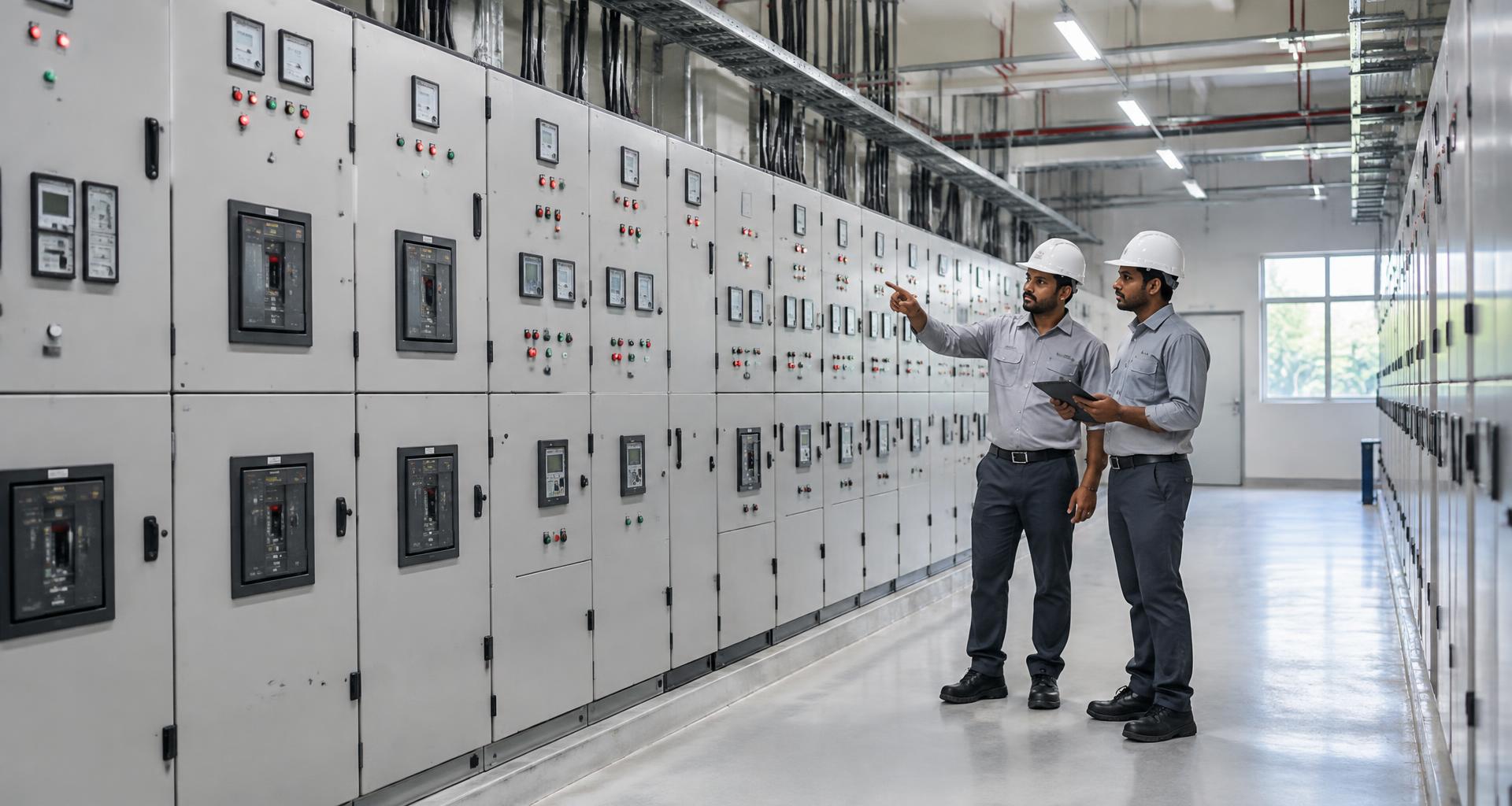
Statutory Earth Pit Testing, Chemical Reconditioning & Resistance Norms: IS 3043 Commercial Guide
A technical operational standard for maintaining, testing, and chemically reconditioning commercial electrical grounding systems and earth pits across Bengaluru in strict compliance with IS 3043 and CEIG statutory regulations.

Statutory earth pit maintenance for commercial facilities in Bengaluru requires scheduled fall-of-potential testing using calibrated four-terminal earth resistance testers to ensure individual pit resistance remains below 1.0 Ohm (and interconnected grid resistance below 0.5 Ohm for data centers). Per IS 3043 and CEIG Karnataka regulations, chemical reconditioning using marconite, bentonite, or carbon-based conductive compounds must be executed when seasonal soil resistivity causes resistance to drift above mandatory thresholds.
Key Engineering Highlights
- Substation body and transformer neutral earth pits must maintain individual resistance below 1.0 Ohm under CEIG Karnataka inspection guidelines.
- Data center clean earth and lightning protection down-conductors require interconnected grid resistance strictly under 0.5 Ohm.
- The four-terminal Fall-of-Potential method (61.8% rule) is the only legally defensible testing protocol accepted during statutory audits.
- Legacy salt-and-charcoal earth pits suffer from rapid chemical leaching and seasonal drying; modern maintenance utilizes maintenance-free chemical compounds.
- Earthing pits must be permanently numbered, labeled (Neutral, Body, Lightning, Clean Earth), and tested pre-monsoon and post-monsoon.
The Critical Role of Grounding in Commercial Electrical Safety
An electrical grounding system is a facility's primary defense against catastrophic arc flash incidents, lightning strikes, static accumulation, and electrocution. During a short circuit or lightning strike, thousands of amperes of fault current must be diverted harmlessly into the earth within milliseconds to trigger upstream circuit breaker tripping.
In Bengaluru's rocky, red laterite soils—prevalent across IT corridors like Whitefield, Electronic City, and Peenya—soil resistivity varies drastically between the dry pre-monsoon summer (April–May) and the post-monsoon saturation period (October–November). Without structured maintenance and moisture management, earth pit resistance can surge to dangerous levels, rendering protection relays unable to detect low-level earth faults.
IS 3043 Testing Methodology: The Fall-of-Potential Protocol
Measuring grounding resistance cannot be performed with standard multi-meters. Testing requires a calibrated digital four-terminal earth resistance tester following the IEEE 81 and IS 3043 Fall-of-Potential procedure:
1. **Disconnection**: The earth pit under test must be physically disconnected from the facility's common grounding grid by unbolting the test link in the earthing inspection chamber.
2. **Current Spike Placement**: The current probe (C2) is driven into the soil at a distance of 30 to 50 meters away from the earth electrode under test (E).
3. **Potential Spike Measurement (61.8% Rule)**: The potential probe (P2) is positioned at 61.8% of the total distance between E and C2. True resistance is confirmed when additional readings taken at 50% and 70% distance align within a 5% tolerance, confirming measurement in the true earth resistance plateau.
Chemical Earth Pit Reconditioning & Advanced Backfill Compounds
Traditional earth pits constructed with alternate layers of common rock salt and wood charcoal suffer from rapid degradation. Salt leaches into deep groundwater tables within 12 to 18 months, causing severe corrosion of the copper-bonded earth electrode and causing soil resistance to rise.
Modern commercial facility maintenance employs maintenance-free chemical earthing systems. Reconditioning involves excavating inspection chambers, removing degraded backfill, and encasing copper-bonded steel electrodes (minimum 250-micron copper bonding per UL 467) in conductive, non-leaching backfill compounds such as marconite or high-grade swelling bentonite clay. These compounds maintain low electrical resistivity (< 0.1 Ohm-meter) even in dry ambient soil conditions.
Statutory CEIG Inspection Documentation & Grid Interconnection
During annual statutory inspections by the Karnataka Electrical Inspectorate, facility operators must present a certified Earth Resistance Register. This register must document:
Numbered layout diagrams matching all physical on-site earth pits.
Individual test values recorded under disconnected test links.
Calibration certificates for the four-terminal earth tester used during the survey.
Signatures of the certified Class-A electrical supervisor who executed the tests.
Frequently Asked Technical Questions
Why does earth pit resistance increase during Bengaluru summers?
Soil electrical conductivity depends heavily on soil moisture content and dissolved ionic minerals. During hot summer months, surface soil moisture evaporates, increasing soil resistivity and causing earth pit resistance readings to spike unless conductive backfill compounds are present.
Can an earth pit be tested without disconnecting it from the main grid?
No. Testing an earth pit while still connected to the common grounding ring yields parallel resistance readings across the entire building grid rather than the specific electrode's true resistance, invalidating the test for statutory compliance.
What is clean earthing in commercial data centers?
Clean earthing (also known as technical or electronic earth) is an isolated grounding network dedicated exclusively to sensitive micro-processor and server hardware, preventing electrical noise, harmonic transients, and ground loops from disrupting digital communications.
How often should earth pits be watered?
Traditional salt-and-charcoal pits require weekly watering through their funnel pipes during dry seasons. Modern chemical earth pits encased in moisture-retaining conductive compounds generally eliminate regular watering, requiring only seasonal inspection.
Engineering standards and operational procedures referenced herein comply with Central Electricity Authority (CEA), CEIG Karnataka, Central Pollution Control Board (CPCB), ASHRAE, and National Building Code (NBC 2016) specifications. Facility assessments by JTechno Associates determine site-specific maintenance scopes for commercial properties across Karnataka.
Ready for zero-surprise uptime?
Start with a conversation. We’ll take it from there.