
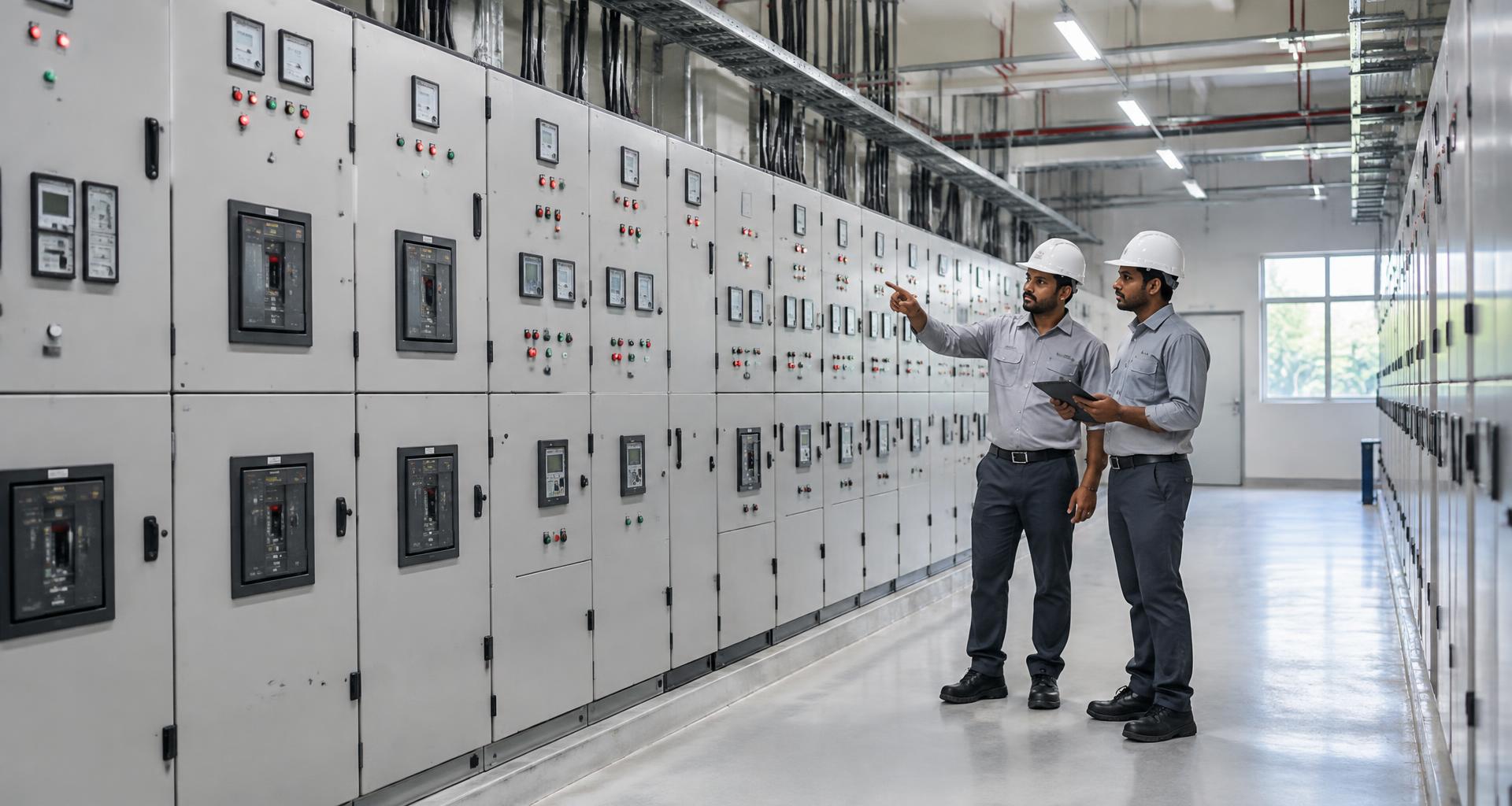
Commercial Diesel Generator (DG) AMC Maintenance Checklist Under CPCB IV+ Norms
Operational engineering guide for commercial diesel generator AMC maintenance, CPCB IV+ emission compliance, B-check/C-check intervals, and load bank testing in Bengaluru tech parks.

Commercial diesel generator AMC maintenance under CPCB IV+ norms requires rigorous execution of tiered servicing—from daily pre-start inspections and 250-hour B-checks to 1,000-hour C-checks and annual load bank testing. JTechno Associates manages 300+ multi-megawatt setups in Bengaluru, ensuring instantaneous AMF grid synchronization and strict particulate emission compliance.
Key Engineering Highlights
- CPCB IV+ norms strictly regulate Particulate Matter (PM) and Nitrogen Oxides (NOx), requiring monitored Retrofit Emission Control Devices (RECD) on older generators.
- The standard B-Check service interval is 250 to 300 operational hours or 6 calendar months, requiring synthetic lube oil, oil filter, and fuel filter replacements.
- Wet stacking from prolonged low-load running (< 30% capacity) must be remediated through annual 100% resistive/reactive load bank testing.
- Diesel fuel polishing every 6 to 12 months prevents asphaltene sedimentation and bacterial sludge from choking common-rail fuel injection pumps.
- Auto-Mains Failure (AMF) control logic must achieve grid-to-generator transfer within 10 to 15 seconds of utility power interruption.
The Critical Role of Standby Diesel Power in Bengaluru IT Corridors
Commercial enterprise hubs across Bengaluru—from the multi-megawatt campuses of Bellandur and Marathahalli to the precision manufacturing lines of Peenya—depend on captive diesel generator sets to guarantee uninterrupted business continuity. While grid reliability from BESCOM has modernized, transient voltage dips, planned feeder shutdowns, and monsoon-related transmission trips require instant, reliable standby generation.
Operating commercial generator sets rated from 500 kVA to 2500 kVA involves significant mechanical, thermal, and regulatory complexities. A standby generator that fails to start during a utility outage renders multi-million-rupee data halls and building automation systems entirely vulnerable. Reliable performance requires moving beyond ad-hoc breakdown repairs to an engineering-driven Annual Maintenance Contract (AMC) framework rooted in preventative diagnostics.
CPCB IV+ Emission Norms & Retrofit Emission Control Devices (RECD)
The Central Pollution Control Board (CPCB) has enforced stringent CPCB IV+ emission standards across India, substantially tightening allowable limits for Particulate Matter (PM), Nitrogen Oxides (NOx), Carbon Monoxide (CO), and unburnt Hydrocarbons (HC). For commercial facilities in Bengaluru, non-compliance with Karnataka State Pollution Control Board (KSPCB) directives can lead to severe operational penalties or closure orders.
For legacy CPCB-II generator sets, facility managers must install approved Retrofit Emission Control Devices (RECD) featuring diesel oxidation catalysts and wall-flow particulate filters capable of reducing PM emissions by at least 70%. In addition, generators must be fitted with dual-fuel kits (converting up to 70% of fuel consumption to piped natural gas) where gas infrastructure exists. Routine AMC inspections must verify RECD backpressure sensors, exhaust temperature monitors, and acoustic enclosure baffle integrity.
The 4-Tier DG Maintenance Hierarchy (A-Check to D-Check)
Effective DG set maintenance follows a standardized four-tier hierarchy determined by engine operating hours and elapsed calendar duration: A-Check (Daily / Pre-Start), B-Check (250–300 Hours or 6 Months), C-Check (800–1000 Hours or 2 Years), and D-Check (2000–3000 Hours / Major Overhaul).
The daily A-Check is executed by on-site technicians before cranking: checking oil levels, coolant expansion tank volume, fuel level in day tanks, drive belt tension, and battery terminal voltage (minimum 24V for dual 12V starter circuits). The bi-annual B-Check represents the core preventive intervention: draining crankcase lubricating oil, replacing primary and secondary fuel filters, replacing full-flow lube oil filter elements, servicing the air filter restriction indicator, and taking lube oil samples for elemental spectroscopic analysis.
- Drain crankcase oil and replace with OEM-approved 15W-40 CI-4/CK-4 lube oil.
- Replace primary water separator and secondary micro-glass fuel filter elements.
- Clean crankcase breather element and inspect turbocharger compressor wheel for play.
- Check coolant DCA (Dry Chemical Additive) concentration and freeze-point protection.
- Inspect starting battery specific gravity (> 1.220) and clean high-amperage terminal leads.
Fuel Management, Storage Hygiene & Fuel Polishing Protocols
Commercial facilities typically maintain bulk High-Speed Diesel (HSD) underground storage tanks holding 10,000 to 50,000 liters. Modern ultra-low sulfur diesel (ULSD) is susceptible to environmental degradation, water absorption, asphaltene agglomeration, and microbial proliferation ('diesel bug'). Contaminated diesel leads to clogged common-rail injectors, fuel pump cavitation, and sudden generator stalls under load.
JTechno Associates integrates multi-stage fuel polishing into commercial DG maintenance programs. Fuel is circulated through mobile filtration rigs featuring centrifugal water separation, 2-micron particulate filtration, and magnetic de-emulsification. Furthermore, fuel day tanks are inspected weekly for water bottoms using water-finding paste, and biological biocides are dosed during seasonal tank turnovers.
Auto-Mains Failure (AMF) Logic, Governor Tuning & Step Load Bank Testing
The electronic governor and Auto-Mains Failure (AMF) synchronizing panel govern whether a generator successfully takes on critical facility loads. Electronic governors must maintain engine speed at exactly 1500 RPM (50 Hz) with steady-state speed band fluctuations under ±0.25%. Frequency dips during block loading must recover within 1.5 seconds to prevent sensitive IT server power supply tripping.
A major threat to commercial generators in modern energy-efficient buildings is 'wet stacking'—the accumulation of unburnt fuel in the exhaust system caused by prolonged operation below 30% of rated capacity. To reverse wet stacking and verify cooling system performance under maximum ambient temperatures, JTechno Associates conducts annual resistive and reactive load bank tests: stepping loads through 25%, 50%, 75%, 100%, and 110% overload conditions while logging exhaust temperatures, oil pressures, and alternator winding thermography.
Acoustic Enclosure & Vibration Isolator Maintenance
Commercial tech parks require strict compliance with ambient noise standards: sound levels must not exceed 75 dB(A) at 1 meter from the acoustic enclosure surface under CPCB guidelines. Maintenance crews must inspect acoustic louvers, motorized intake/exhaust dampers, rockwool acoustic insulation cladding, and residential-grade exhaust silencers.
Anti-Vibration Mounts (AVMs) installed between the engine-alternator sub-base and the building floor isolate low-frequency structural vibration. AVM spring deflection and elastomeric damping pads must be inspected bi-annually; deteriorated isolators cause acoustic drumming that transmits through concrete structural slabs into tenant office floors above.
| Service Tier | Execution Interval | Mandatory Scope of Work | Critical Validation Parameter |
|---|---|---|---|
| A-Check | Daily / Every Shift | Lube oil, coolant, fuel, battery check, leak walkaround | Battery > 24V DC, zero fluid drips |
| B-Check | 250-300 Hrs / 6 Months | Lube oil & filter, fuel filters, bypass filter, air cleaner | Oil analysis: Viscosity, TBN > 6.0 |
| C-Check | 800-1000 Hrs / 2 Years | Tappet valve lash setting, injector cleaning, turbo check | Valve clearance within ±0.05 mm |
| D-Check | 2000-3000 Hrs / Overhaul | Piston rings, cylinder liners, big-end bearings, cylinder head | Compression ratio restored to OEM |
| Load Bank | Annual Testing | Step load test from 25% up to 100% rated capacity | Zero wet stacking, temp delta < 10°C |
| Fuel Polishing | Bi-Annual / Annual | Recirculation filtration, water separation, biocide dosing | Particulate count < ISO 18/16/13 |
Frequently Asked Technical Questions
What causes wet stacking in commercial diesel generators, and how is it corrected?
Wet stacking occurs when a diesel engine operates continuously below 30% to 40% of its rated capacity. Low cylinder combustion temperatures prevent complete fuel burn, allowing unburnt diesel and carbon soot to accumulate in the exhaust manifold and turbocharger. It is corrected by running the generator on a 100% resistive load bank for 2 to 4 hours to burn off deposits.
What are the CPCB IV+ emission standards for commercial DG sets in Karnataka?
CPCB IV+ standards, effective since mid-2024, mandate a 90% reduction in Particulate Matter (PM) and significant cuts in Nitrogen Oxides (NOx) compared to CPCB-II norms. For existing generators, KSPCB mandates fitting approved Retrofit Emission Control Devices (RECD) or dual-fuel natural gas conversion kits.
How long does a generator have to restore power during a utility outage in an IT park?
For commercial Grade-A facilities, the AMF panel is programmed to crank and synchronize the generator set within 7 to 10 seconds of utility power loss, transferring critical loads to the bus within 15 seconds. UPS systems bridge the gap to ensure zero server disruption.
What tests are performed on DG starting batteries during routine maintenance?
Technicians measure open-circuit terminal voltage, individual cell specific gravity using an optical refractometer (target 1.240-1.260), cranking voltage drop (must not dip below 18V during cranking), and internal cell conductance using a digital battery analyzer.
Why is spectroscopic lubricating oil analysis important in DG AMC contracts?
Used oil analysis checks kinematic viscosity, Total Base Number (TBN), soot loading, and wear metal traces (iron, copper, lead, chromium). Detecting high iron indicates cylinder liner wear, while copper points to bearing wear, allowing corrective action before catastrophic engine seizure.
Related Critical Facility Management Services
Commercial Diesel Generator AMC
Comprehensive multi-megawatt DG maintenance, synchronization, and fuel management programs.
Electrical Substation Operations
Seamless integration between HT grid power, VCB switchgear, and emergency standby generators.
Commercial UPS Systems & Audits
Uninterrupted power transition bridging utility outages to standby generator ignition.
Facility Manpower Outsourcing
Certified DG operators and electrical technicians providing 24/7 on-site plant coverage.
Engineering standards and operational procedures referenced herein comply with Central Electricity Authority (CEA), CEIG Karnataka, Central Pollution Control Board (CPCB), ASHRAE, and National Building Code (NBC 2016) specifications. Facility assessments by JTechno Associates determine site-specific maintenance scopes for commercial properties across Karnataka.
Ready for zero-surprise uptime?
Start with a conversation. We’ll take it from there.