
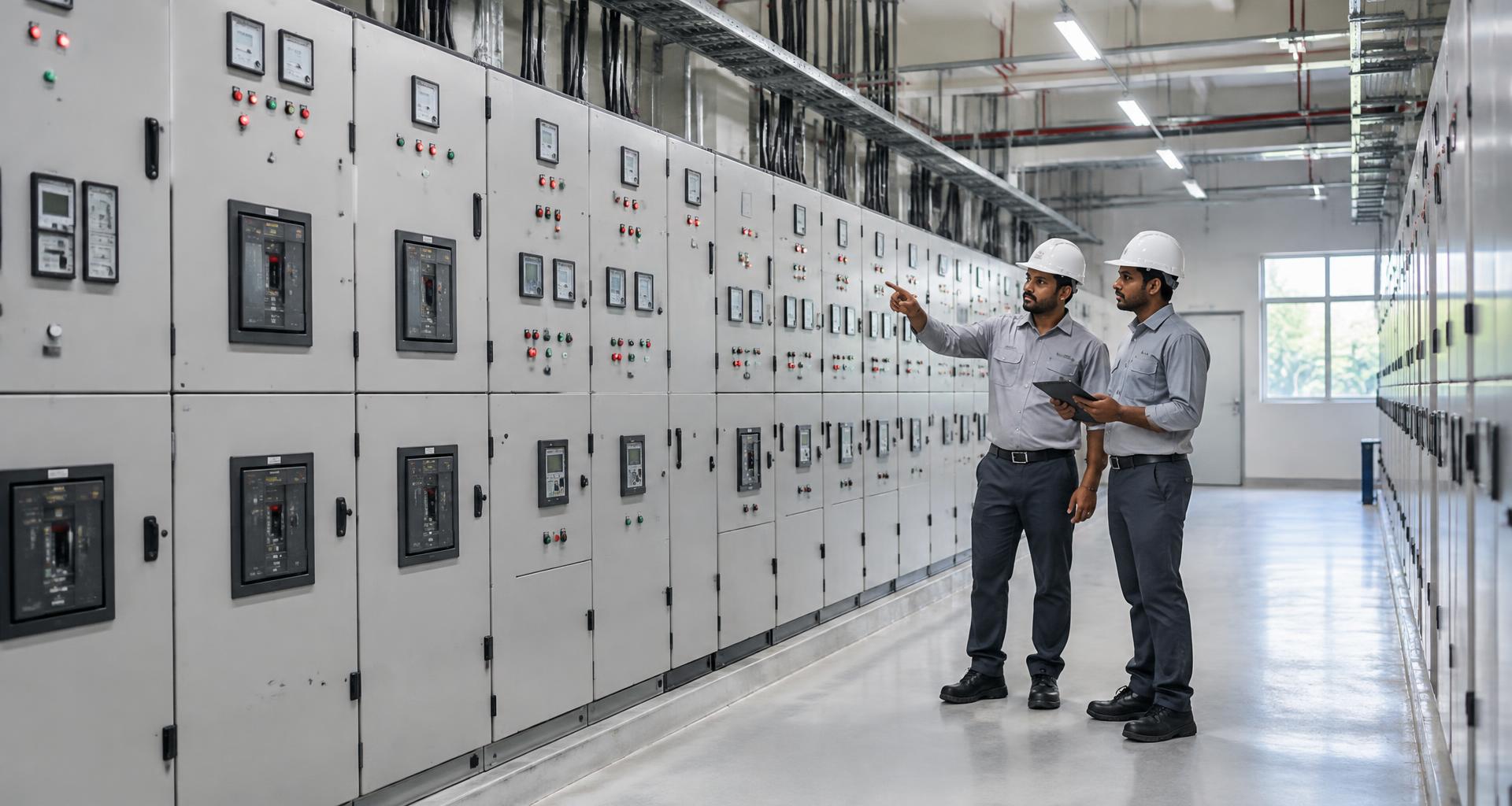
Data Center Critical Power & Cooling: Uptime Standards & Engineering Guide
Engineering manual for data center infrastructure operations, covering N+1 and 2N power redundancy, precision CRAC/CRAH thermal management, hot/cold aisle containment, and zero-downtime maintenance.

Data center infrastructure management in Bengaluru requires rigorous 2N power redundancy, continuous precision thermal management through CRAC/CRAH units, and strict hot/cold aisle containment adhering to Uptime Institute Tier III/IV standards. JTechno Associates delivers dedicated critical environment engineering ensuring 99.999% power and thermal availability for enterprise data halls and colocation facilities.
Key Engineering Highlights
- Tier III concurrent maintainability requires dual independent power and cooling distribution paths without interrupting server loads.
- Precision Cooling (CRAC/CRAH) must maintain ASHRAE TC 9.9 thermal envelopes (18°C–27°C dry bulb, 5.5°C dew point).
- Hot and cold aisle containment systems prevent thermal recirculation, reducing server fan energy consumption and boosting chiller efficiency by up to 30%.
- Dual-bus 2N UPS configurations eliminate single points of failure across critical static transfer switches (STS) and power distribution units (PDU).
- Disciplined Method of Procedure (MOP) and Standard Operating Procedure (SOP) governance prevents human error during live electrical switching.
The High-Stakes World of Critical Environment Operations in Bengaluru
Bengaluru has emerged as one of the fastest-growing data center and cloud computing hubs in the Asia-Pacific region. From hyper-scale data facilities in Whitefield and Mahadevapura to enterprise edge computer rooms across Electronic City and the Central Business District (CBD), data centers form the backbone of modern digital commerce. In these mission-critical environments, the cost of downtime is measured not in thousands of rupees, but in tens of lakhs per second.
Unlike conventional commercial office buildings, data centers operate under extreme power density (frequently exceeding 8 to 15 kW per server rack) and relentless 24/7/365 thermal loads. The margin for operational error is zero. Achieving the coveted 'five nines' (99.999%) availability requires sophisticated engineering topology, continuous environmental telemetry, and an unwavering commitment to preventive maintenance executed under strict procedural governance.
Power Architecture: N+1 vs 2N Redundancy & Dual-Bus Topologies
The electrical backbone of any Tier III or Tier IV data center is designed around concurrent maintainability and fault tolerance. In a Tier III architecture, every piece of critical capacity equipment—transformers, diesel generators, UPS modules, and static transfer switches (STS)—must feature redundant paths allowing maintenance without taking live IT workloads offline.
A true 2N power topology deploys two completely independent, electrically isolated power delivery systems (System A and System B). Each system features its own utility feed, dedicated standby generator bank, synchronized automatic transfer switch (ATS), and modular double-conversion online UPS array. Enterprise servers equipped with dual power supply units (PSUs) draw load simultaneously from both buses. Routine maintenance—such as testing UPS battery strings, recalibrating trip coils, or servicing input breakers—can be performed on Bus A while Bus B carries the full data hall load without a millisecond of voltage distortion.
- Execute monthly infrared thermography across all PDU breaker terminations and STS connections.
- Perform automated battery discharge impedance testing on individual UPS VRLA/Lithium cells.
- Test static bypass synchronization and phase-angle lock between dual independent UPS buses.
- Verify automatic generator starting and closed-transition transfer under simulated grid blackout.
- Audit transient voltage surge suppressor (TVSS) integrity and secondary surge arrestors.
Precision Cooling Architecture: CRAC, CRAH & ASHRAE TC 9.9 Envelopes
Cooling a high-density data hall is an engineering discipline distinct from comfort air conditioning. Enterprise servers generate massive quantities of dry, sensible heat without moisture, requiring precision Computer Room Air Conditioners (CRAC) or Computer Room Air Handlers (CRAH) designed for high sensible heat ratios (SHR > 0.95).
Operations must adhere strictly to ASHRAE Technical Committee 9.9 environmental guidelines for mission-critical facilities. The recommended operating envelope specifies an IT inlet air temperature range of 18°C to 27°C (64.4°F to 80.6°F) and a relative humidity window maintaining dew points between 5.5°C and 15°C. Operating outside this envelope creates severe operational hazards: excessive temperatures induce server thermal throttling and hardware failure, while low humidity promotes dangerous electrostatic discharge (ESD) that can instantly destroy sensitive server silicon.
Aisle Containment Optimization & CFD Thermal Profiling
In legacy uncontained data halls, cold supply air from raised access floors freely mixes with hot server exhaust air, leading to localized thermal hotspots and massive chiller energy inefficiency. Modern data infrastructure engineering relies on Hot Aisle Containment (HAC) or Cold Aisle Containment (CAC) to physically segregate supply and return air streams.
Under Cold Aisle Containment, transparent ceiling canopies and end-of-aisle sliding doors enclose the server intake corridor, maintaining a pressurized, uniform 21°C cold air reservoir. Computational Fluid Dynamics (CFD) modeling conducted across enterprise data centers in Bengaluru demonstrates that containment enables chilled water supply temperatures to be safely elevated from 7°C to 12°C. This 5°C elevation increases chiller COP (Coefficient of Performance), yielding a 15% to 22% reduction in overall data center Power Usage Effectiveness (PUE).
Zero-Downtime Governance: MOP, SOP & Incident Response Protocols
Industry studies by the Uptime Institute consistently reveal that over 70% of data center outages are triggered not by mechanical or electrical equipment breakdown, but by human operational error during scheduled maintenance. In a high-availability facility, technical competence must be paired with rigorous procedural governance.
JTechno Associates enforces a strict Three-Way Communication and Method of Procedure (MOP) protocol for every physical intervention within critical environments. Before a technician touches a breaker or valve, an exhaustive MOP document details the precise sequence of steps, required safety PPE, backout contingency plans, and real-time verification checkpoints. Furthermore, on-site critical facility teams execute quarterly simulated disaster drills, practicing black-start generator synchronizations, emergency bypass transfers, and FM200/Novec fire suppression isolation protocols.
| Uptime Tier Level | Redundancy Topology | Distribution Paths | Concurrent Maintainability | Annual Downtime Limit |
|---|---|---|---|---|
| Tier I: Basic Capacity | N (Single system, no redundancy) | Single distribution path for power and cooling | No (Requires full facility shutdown for repairs) | Up to 28.8 hours / year |
| Tier II: Redundant Capacity | N+1 (Redundant components) | Single distribution path with redundant components | No (Shutdown required for distribution maintenance) | Up to 22.0 hours / year |
| Tier III: Concurrently Maintainable | N+1 or 2N (Active/Passive) | Dual paths (1 active, 1 alternate) for power/cooling | Yes (Any component removed without load disruption) | Max 1.6 hours / year (99.982% uptime) |
| Tier IV: Fault Tolerant | 2(N+1) or 2N (Active/Active) | Dual simultaneously active independent paths | Yes (Compartmentalized fault tolerance across all paths) | Max 0.4 hours / year (99.995% uptime) |
Frequently Asked Technical Questions
What is the difference between N+1 and 2N redundancy in data center power design?
N+1 provides one spare component for every operational group (e.g., 4 UPS units serving the load plus 1 backup). In contrast, 2N provides a completely duplicated mirror architecture (e.g., two identical, independent power chains), ensuring full continuous operation even if an entire distribution path fails.
Why is Cold Aisle Containment (CAC) preferred over uncontained data room layouts?
Cold Aisle Containment prevents hot server exhaust air from mixing with conditioned cold air. This eliminates thermal hotspots, stabilizes server inlet temperatures within ASHRAE standards, and allows facility chillers to operate at higher setpoints, drastically reducing PUE.
What is a Method of Procedure (MOP) and why is it mandatory in critical data operations?
A Method of Procedure (MOP) is a step-by-step technical script detailing the exact sequence of actions, safety prerequisites, tool requirements, and backout rollback steps for any maintenance activity. It eliminates human switching errors during live operational work.
What are the recommended ASHRAE TC 9.9 server inlet temperature standards?
ASHRAE TC 9.9 specifies a recommended server intake dry-bulb temperature range of 18°C to 27°C (64.4°F to 80.6°F), with relative humidity maintaining a dew point between 5.5°C and 15°C and maximum relative humidity not exceeding 60%.
How frequently must data center emergency diesel generators undergo full load testing?
Emergency diesel generators must undergo monthly no-load/light-load exercise runs, and semi-annual or annual full-capacity load bank testing (operating at 100% rated load for 2 to 4 hours) to clear engine carbon glazing and verify cooling system capacity under full thermal load.
Related Critical Facility Management Services
Commercial UPS Systems & Audits
High-density data center power quality, static bypass, and battery string health audits.
Commercial Chiller & HVAC Maintenance
Precision CRAC/CRAH servicing, cold aisle optimization, and high-efficiency chiller plant O&M.
Electrical Substation O&M Services
Dual-utility HT feed management, vacuum switchgear testing, and transformer reliability.
Commercial Diesel Generator AMC
Emergency standby power synchronizing, AMF automation, and load bank validation.
Engineering standards and operational procedures referenced herein comply with Central Electricity Authority (CEA), CEIG Karnataka, Central Pollution Control Board (CPCB), ASHRAE, and National Building Code (NBC 2016) specifications. Facility assessments by JTechno Associates determine site-specific maintenance scopes for commercial properties across Karnataka.
Ready for zero-surprise uptime?
Start with a conversation. We’ll take it from there.