
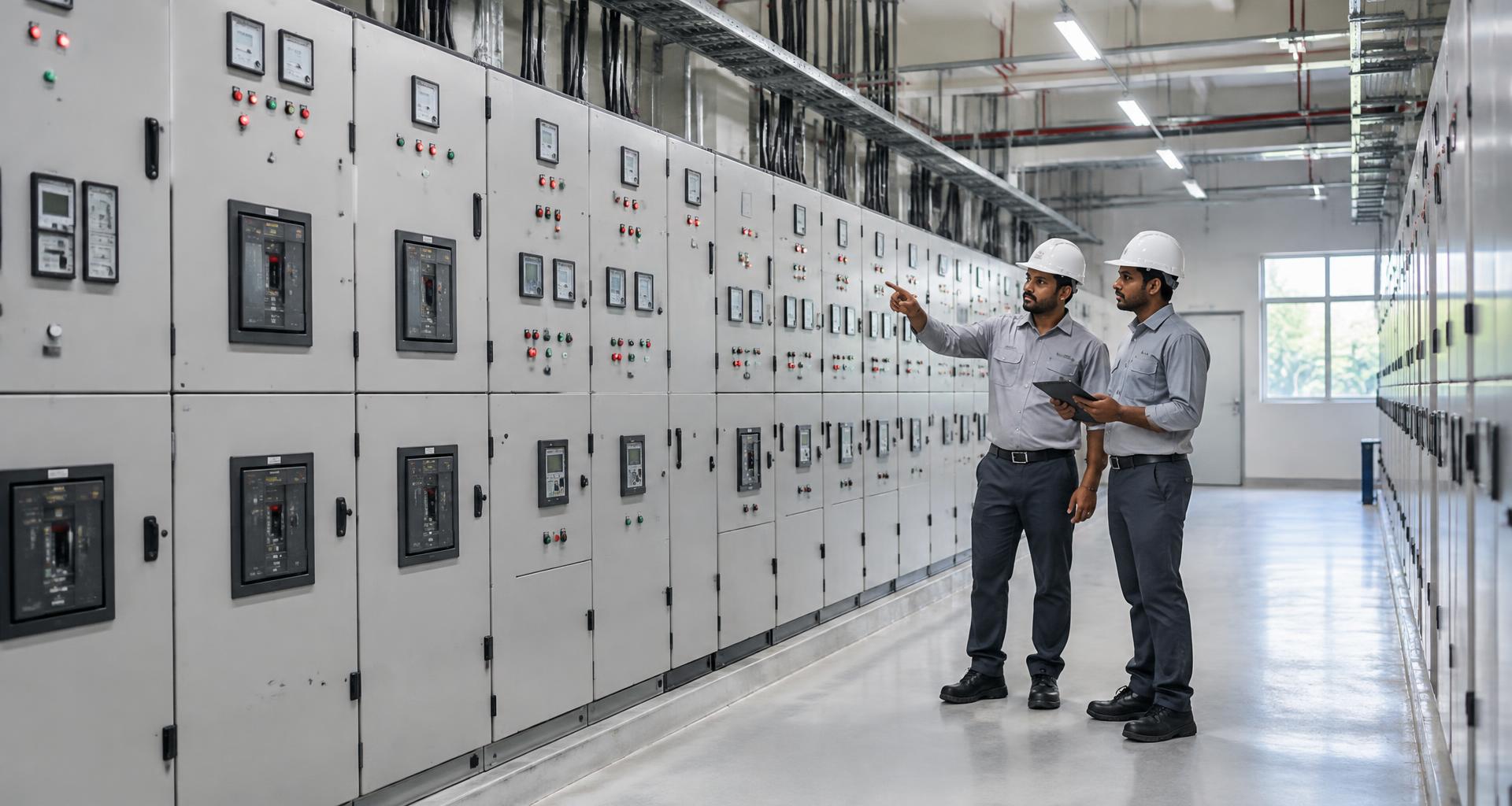
Commercial UPS System Maintenance & Battery Bank Impedance Audit Protocols
Technical engineering guide on commercial UPS maintenance, VRLA/Lithium battery cell impedance testing, DC capacitor replacement, and static bypass synchronization in Bengaluru.

Commercial UPS system maintenance requires quarterly internal battery cell impedance testing, thermal imaging of DC bus capacitors, and dynamic static bypass synchronization to ensure zero micro-outages. JTechno Associates deploys certified electrical technicians across Bengaluru data centers and trading floors to guarantee 99.999% power availability and rapid fault isolation.
Key Engineering Highlights
- Over 80% of commercial UPS downtime incidents trace back directly to unmonitored battery cell failure within multi-tier battery strings.
- Internal cell impedance testing detects dry-out and plate sulfation well before a cell drops below open-circuit float voltage.
- DC bus electrolytic filter capacitors have an operational lifespan of 5 to 7 years; aging capacitors risk catastrophic explosive venting.
- Static bypass switch silicon-controlled rectifiers (SCRs) must be synchronized within 3 electrical degrees to guarantee sub-4ms transfer times.
- Infrared thermographic surveys under live full-load conditions identify high-resistance inter-cell busbar connections and terminal hot joints.
Mission-Critical UPS Topologies in Modern Bengaluru Enterprise Facilities
Commercial enterprise hubs, fintech trading operations, and mission-critical cloud hosting facilities across Bengaluru's tech sectors cannot tolerate even a 10-millisecond voltage drop. Voltage fluctuations, harmonic distortion, and utility grid transfers must be completely isolated from critical server loads. Online double-conversion Uninterruptible Power Supply (UPS) systems (VFI-SS-111 under IEC 62040-3) provide the critical power bridge between utility power, diesel generators, and IT equipment racks.
Maintaining commercial UPS systems rated from 100 kVA to multi-megawatt parallel redundant configurations requires specialized power electronics engineering expertise. Unlike standard electro-mechanical equipment, static power electronic converters operate with high-speed IGBT switching, sensitive DC link buses, and electrochemical energy storage arrays where a single degraded battery cell can cause the entire system to trip into fault mode during an outage.
Modular vs. Monolithic UPS Architecture: MTBF & MTTR Comparison
Modern facilities evaluate two primary architectures: legacy standalone monolithic UPS frames or scalable modular rack-mounted systems. Monolithic systems offer robust fault tolerance against extreme downstream short-circuit currents, but their Mean Time to Repair (MTTR) can extend from 6 to 24 hours if an internal inverter phase module fails, requiring component-level soldering and field calibration.
In contrast, modular UPS architectures utilize hot-swappable 25 kVA to 100 kVA power modules in an N+1 or N+2 configuration. If an internal module experiences a fault, the intelligent controller isolates that module in sub-cycle time while remaining modules carry the load without dropping to bypass. Mean Time to Repair is reduced to under 30 minutes. However, modular architectures demand rigorous quarterly backplane connector inspections, firmware synchronization, and module-level current sharing calibrations.
Battery Bank Health: Internal Resistance & Conductance Audit Protocols (VRLA vs. LiFePO4)
The battery bank represents the most vulnerable element in any critical power chain. Over 80% of unplanned UPS load drops result directly from battery failure. Traditional Valve-Regulated Lead-Acid (VRLA) batteries suffer from electrolyte dry-out, positive grid corrosion, and negative plate sulfation. Crucially, a dying VRLA cell can display normal open-circuit float voltage (e.g. 13.5V for a 12V block) while its internal impedance has doubled, causing terminal voltage collapse the instant an actual discharge load hit occurs.
JTechno Associates executes comprehensive battery audits using digital micro-ohmmeter conductance and impedance analyzers (such as Megger BITE or Hioki testers). Baseline impedance is logged for every individual block during commissioning; any block exhibiting a 25% to 30% increase over baseline impedance, or a 20% drop in conductance, is flagged for replacement. Furthermore, where modern Lithium Iron Phosphate (LiFePO4) battery systems are installed, maintenance engineers audit internal Battery Management System (BMS) telemetry, cell voltage balance (< 15 mV delta), and active thermal dissipation channels.
- Measure individual cell float voltage, string float current, and ripple voltage.
- Log internal cell impedance (micro-ohms) and compare against baseline commissioning values.
- Torque inter-tier cable bolts to OEM specifications (typically 10–12 Nm) using calibrated torque wrenches.
- Conduct infrared thermography across all battery post terminals during heavy discharge/charge cycles.
- Verify battery room hydrogen exhaust ventilation and ambient temperature control (maintained at 22°C–24°C).
Thermal Imaging, DC Capacitor Degradation & IGBT Inverter Servicing
Inside the UPS cabinet, rectifier and inverter sections utilize Insulated Gate Bipolar Transistors (IGBTs) switching at frequencies from 2 kHz to 15 kHz. This high-frequency switching generates heat that must be dissipated by internal cooling fan arrays and aluminum heat sinks. Quarterly maintenance audits use calibrated thermal imaging cameras to inspect thermal distribution across semiconductors, DC busbars, and isolation transformers.
Electrolytic DC bus capacitors and AC filter capacitors have a finite chemical lifespan of 5 to 7 years. As internal electrolyte evaporates, equivalent series resistance (ESR) increases, causing capacitor heating and elevated AC ripple voltage on the DC bus. High ripple voltage accelerates battery heating and can cause unexpected inverter shutdowns. JTechno Associates measures AC ripple voltage across the DC bus (target < 1.0% RMS) and executes planned capacitor bank replacement cycles before catastrophic dielectric venting occurs.
Static Bypass Switch Testing & Dual-Utility Synchronization
The static bypass switch—comprising back-to-back Silicon Controlled Rectifiers (SCRs)—provides a seamless, zero-break safety path to bypass utility power if the inverter experiences a severe overload, short-circuit, or internal fault. To execute a seamless transfer (typically under 2 to 4 milliseconds), the inverter output must be continuously phase-locked with the bypass utility source.
Maintenance engineers verify the phase-lock loop (PLL) tracking window: if utility frequency drifts beyond ±1.0 Hz, the UPS controller safely inhibits bypass transfer to prevent catastrophic out-of-phase cross-currents. Annual testing involves controlled simulated transfer tests to confirm that downstream server rack Power Distribution Units (PDUs) and Static Transfer Switches (STS) experience zero waveform discontinuity.
Designing Zero-Downtime Maintenance SLAs for Financial & Tech Operations
In financial trading facilities and global enterprise NOCs, routine UPS maintenance cannot take the system offline. Facilities employ dual-bus (2N) architecture where Server Rack A is fed by UPS System 1 and Server Rack B is fed by UPS System 2 via dual-corded server power supplies. Maintenance is executed on one complete power train while the alternate power train seamlessly carries 100% of the facility load.
JTechno Associates formalizes strict Service Level Agreements (SLAs) including 15-minute emergency technician dispatch in Bengaluru, 2-hour root-cause triage, on-site spare part provisioning (cooling fans, control cards, bypass SCRs), and automated monthly health reporting submitted directly to corporate infrastructure directors.
| Subsystem | Inspection / Diagnostic Protocol | Acceptable Tolerance / Threshold | Frequency |
|---|---|---|---|
| VRLA Battery Bank | Internal cell impedance & conductance | Impedance delta < 25% from baseline | Quarterly Audit |
| Battery Terminals | Calibrated torque audit & thermography | Torque to 11 Nm; Delta-T < 2.0°C | Bi-Annual |
| DC Bus Capacitors | AC ripple voltage measurement | Ripple < 1.0% of total DC float voltage | Bi-Annual / Annual |
| Static Bypass Switch | Phase-lock synchronization test | Phase angle delta < 3°; Transfer < 4 ms | Annual Maintenance |
| Cooling Fans | Bearing acoustic check & RPM telemetry | RPM within ±5% of design rating | Quarterly Check |
| Environmental Room | Ambient temperature & hydrogen exhaust | Temp 22°C–24°C; H2 sensor alarm active | Continuous / Weekly |
Frequently Asked Technical Questions
Why can a VRLA battery show normal float voltage but fail during an outage?
VRLA batteries on float charge can display normal terminal voltage (13.5V to 13.8V for a 12V block) despite having lost 70% of their actual energy capacity due to plate dry-out or internal grid corrosion. Only an internal impedance test or controlled discharge test reveals that the cell cannot sustain discharge current under load.
What is the recommended ambient room temperature for commercial UPS battery rooms?
The optimal room temperature for VRLA battery rooms is 22°C to 24°C (72°F to 75°F). Operating VRLA batteries at elevated temperatures drastically shortens operational life: every 8°C (15°F) continuous increase above 25°C cuts battery design life in half.
How long do internal UPS DC filter capacitors last before requiring replacement?
Electrolytic DC bus filter capacitors have an operational lifespan of 5 to 7 years in temperature-controlled environments. Facilities should plan proactive capacitor bank replacements between years 5 and 6 to avoid catastrophic explosive venting and PCB damage.
What is the difference between a dynamic transfer and a maintenance bypass?
A dynamic transfer is executed automatically by solid-state electronic static bypass switches (SCRs) within 2 to 4 milliseconds during an inverter fault. A maintenance bypass is a physical, manual rotary switch that completely isolates the UPS cabinet for servicing while utility power flows through an external circuit.
What is the uptime difference between an N+1 and a 2N UPS configuration?
An N+1 configuration features a single power bus with one redundant module (e.g., four 100 kVA modules handling a 300 kVA load). A 2N configuration features two completely independent UPS systems and distribution paths (System A and System B), delivering true fault tolerance and allowing complete concurrent maintenance without risk.
Related Critical Facility Management Services
Commercial UPS Systems & Audits
Power quality assurance, battery impedance audits, and modular UPS preventive maintenance.
Electrical Substation Operations
Substation HT/LT breaker coordination ensuring clean utility input to upstream UPS rectifiers.
Commercial Diesel Generator AMC
Standby power synchronization pairing DG output with UPS battery holdover times.
Building Management Systems
Real-time SNMP/Modbus UPS telemetry integration into central monitoring dashboards.
Engineering standards and operational procedures referenced herein comply with Central Electricity Authority (CEA), CEIG Karnataka, Central Pollution Control Board (CPCB), ASHRAE, and National Building Code (NBC 2016) specifications. Facility assessments by JTechno Associates determine site-specific maintenance scopes for commercial properties across Karnataka.
Ready for zero-surprise uptime?
Start with a conversation. We’ll take it from there.