
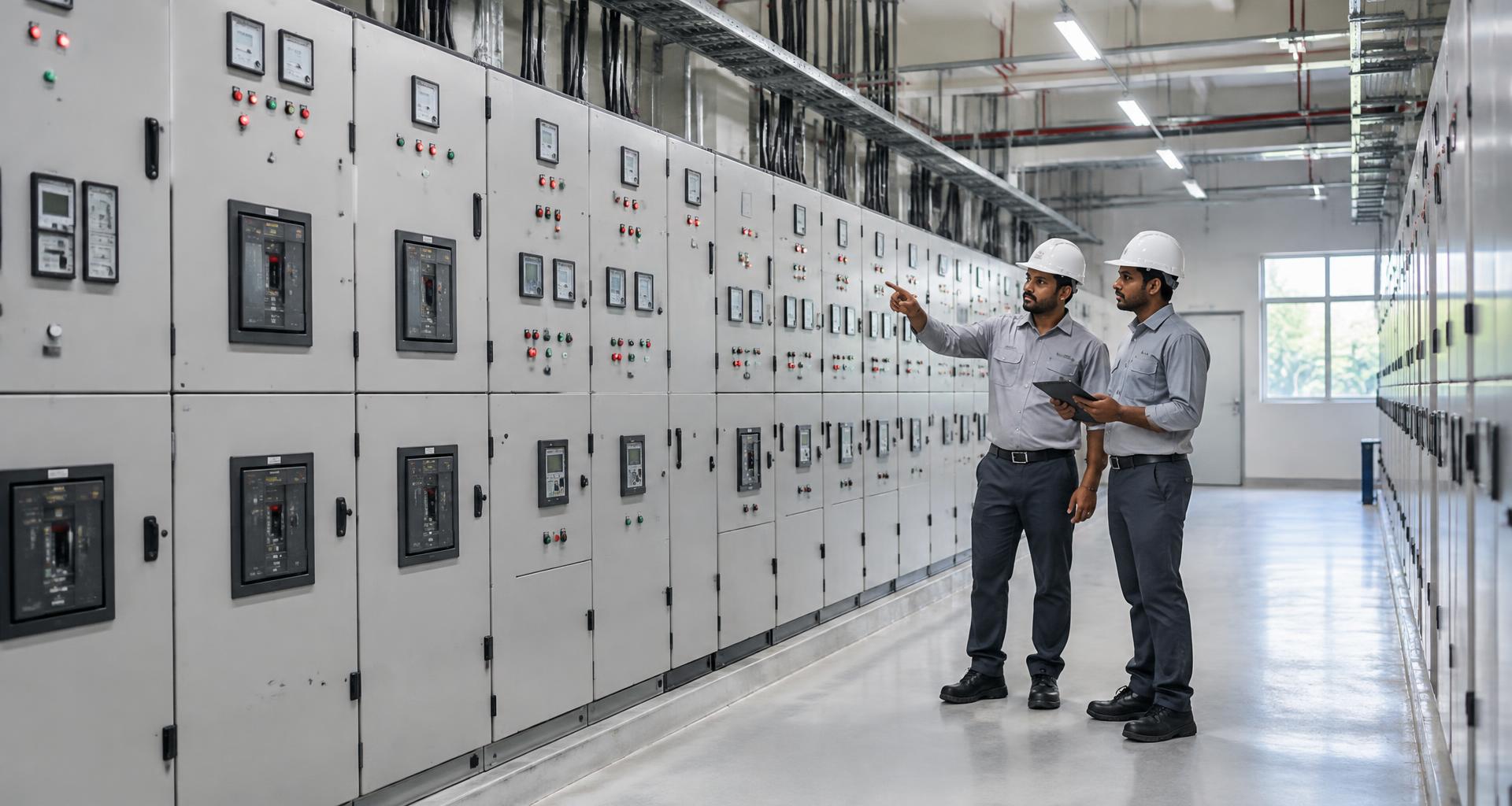
AMC vs CAMC for Electro-Mechanical Equipment: The Commercial Facility Guide
Strategic financial and technical comparison of Annual Maintenance Contracts (AMC) vs Comprehensive AMCs (CAMC) for commercial building infrastructure, risk allocation, and budget optimization.

The choice between an Annual Maintenance Contract (AMC) and a Comprehensive Annual Maintenance Contract (CAMC) hinges on risk allocation and equipment age. AMCs cover routine labor and scheduled servicing, leaving parts replacement costs to the owner, whereas CAMCs include labor, repair spares, and consumable components within a fixed fee. For critical assets like chillers and UPS systems, CAMCs provide predictable budgeting and minimized downtime.
Key Engineering Highlights
- AMCs provide low upfront annual costs but expose commercial facilities to unpredictable repair bills when major mechanical failures occur.
- CAMCs act as an operational insurance policy, covering high-cost component replacements (compressors, VCB trip coils, PCB boards) within a predictable annual budget.
- Hybrid contract models—combining CAMC on mission-critical assets (chillers, UPS) and AMC on standard static equipment (distribution panels)—optimize facility ROI.
- Scrutinizing contract exclusions (such as motor rewinding limits, refrigerant top-ups, and battery banks) prevents unbudgeted out-of-scope expenditures.
- Service Level Agreements (SLAs) with penalty clauses for failure to achieve Mean Time to Repair (MTTR) thresholds are vital in both AMC and CAMC structures.
Navigating Maintenance Contracting in Commercial Real Estate
Commercial real estate managers and chief engineers across Bengaluru's high-density business hubs—such as the Outer Ring Road, Manyata Embassy Business Park, and Whitefield—manage complex portfolios of electro-mechanical infrastructure. From high-tonnage centrifugal chillers and multi-megawatt diesel generators to vacuum circuit breakers and water treatment plants, maintaining high reliability while controlling annual operating expenditure (OPEX) is a perpetual balancing act.
One of the most consequential procurement decisions facility leaders face is choosing between a non-comprehensive Annual Maintenance Contract (AMC) and a Comprehensive Annual Maintenance Contract (CAMC). While an AMC offers an attractive lower headline price during annual budgeting, an unforeseen compressor burnout or alternator stator failure can immediately erase projected savings. Selecting the appropriate contractual framework requires rigorous life-cycle cost modeling, asset risk profiling, and clear contract governance.
Deconstructing AMC: Scope, Benefits & Latent Financial Risks
A standard Annual Maintenance Contract (often termed a Non-Comprehensive or Labor-Only AMC) covers scheduled routine inspections, preventive adjustments, filter cleaning, and basic minor consumables (such as lubricants, grease, and contact cleaner). The service provider commits technical engineering hours at fixed intervals—monthly, quarterly, or bi-annually—to ensure equipment operates within design parameters.
However, when an asset experiences component degradation or an emergency breakdown, the cost of all replacement parts, major overhauls, and specialized machining falls entirely on the facility owner. Beyond direct component costs, non-comprehensive contracts often suffer from operational latency: when a critical chiller component fails, work cannot commence until the vendor submits a formal spare part quotation, the facility team generates a Purchase Order (PO), and procurement completes corporate approvals. In mission-critical environments like data centers or financial tech hubs, this administrative delay can extend equipment downtime from hours to weeks.
Deconstructing CAMC: Total Coverage, Risk Transfer & Cost Predictability
A Comprehensive Annual Maintenance Contract (CAMC) transfers the financial and operational risk of equipment failure to the engineering service provider. Under a CAMC, the annual contract fee covers all preventive servicing, emergency breakdown labor, routine consumable replacements, and—crucially—the replacement or reconditioning of worn and failed mechanical and electrical components at zero additional cost to the client.
For asset classes subject to high thermodynamic stress and continuous operational wear—such as water-cooled screw and centrifugal chillers, high-speed diesel generator engines, precision air conditioners (PAC), and uninterrupted power supply (UPS) internal power modules—CAMC contracts offer unparalleled financial predictability. Corporate finance heads benefit from fixed annual OPEX without the volatility of emergency capital requests. Moreover, because the vendor absorbs the financial burden of part failures, they are structurally incentivized to perform diligent preventive maintenance that prevents breakdowns before they occur.
- Define explicit inclusions for high-value components (e.g., chiller compressor overhauls, PCB controller replacements).
- Specify refrigerant gas replenishment terms (e.g., inclusion of top-ups resulting from normal mechanical seal wear).
- Incorporate rigorous Mean Time to Respond (MTTR) and Mean Time to Restore metrics with clear liquidated damages.
- Verify OEM-genuine parts commitment with traceability certificates for all installed spares.
- Mandate dedicated on-site emergency spare inventory for high-turnover wear items.
Comparative Matrix: Cost, Risk Allocation & SLA Governance
Choosing between AMC and CAMC is fundamentally an exercise in risk engineering. Commercial facility directors must evaluate three core variables: Asset Criticality (the financial cost of downtime per hour), Asset Maturity (where the equipment sits on the bathtub failure curve), and Spare Availability (lead times for imported OEM components).
New equipment in years 1 through 3 typically exhibits low failure rates, making an AMC or OEM labor contract cost-effective. However, as electro-mechanical assets enter their mid-life cycle (years 4 through 10), mechanical fatigue, thermal expansion stresses, and electrical insulation degradation dramatically increase the probability of major component failures. During this operational phase, transitioning to a CAMC provides essential budgetary hedging.
Hybrid Contracting Strategy: The Optimal Commercial Real Estate Model
Leading corporate facilities across Bengaluru rarely apply a blanket contracting model across all infrastructure assets. Instead, enlightened facility directors implement an Asset-Criticality Matrix to deploy a hybrid contracting strategy that maximizes reliability while optimizing annual budgets.
Under this hybrid framework, Tier-1 mission-critical assets (such as central chillers, commercial UPS systems, and primary 11kV switchgear) are covered under full CAMCs. Concurrently, Tier-2 and Tier-3 secondary infrastructure—such as static distribution panels, plumbing booster pumps, exhaust fans, and water softening systems—are managed under cost-effective AMCs paired with pre-approved emergency spares rate contracts. JTechno Associates partners with enterprise clients to conduct comprehensive equipment condition assessments, formulating tailored contracting strategies that yield up to 20% savings in overall facility lifecycle expenditures.
| Evaluation Parameter | Standard AMC (Non-Comprehensive) | Comprehensive AMC (CAMC) | Strategic Recommendation |
|---|---|---|---|
| Upfront Contract Pricing | Low baseline fee (30–40% lower than CAMC) | Higher upfront fee (includes insurance premium) | Use AMC for non-critical, simple static assets |
| Spare Parts Replacement | Billed separately at actuals per incident | Included 100% within annual contract fee | CAMC essential for high-wear mechanical assets |
| Emergency Repair Downtime | High latency (awaiting quotations and PO approvals) | Fast resolution (vendor dispatches spares immediately) | CAMC mandatory for zero-downtime operations |
| Vendor Maintenance Incentive | Low (vendor earns additional revenue from parts) | High (vendor absorbs costs of avoidable failures) | CAMC aligns vendor incentives with client uptime |
| Budgeting Predictability | High volatility (unpredictable breakdown expenses) | Fixed, deterministic annual OPEX | CAMC preferred by corporate finance teams |
| Refrigerant & Oil Top-ups | Excluded (billed per kg / liter) | Typically included up to specified limits | Scrutinize contract clauses during procurement |
| Asset Lifecycle Longevity | Moderate (reactive component replacement) | High (aggressive preventive care to protect vendor) | CAMC extends useful operational lifespan |
Frequently Asked Technical Questions
When is a standard AMC more cost-effective than a CAMC for commercial buildings?
An AMC is optimal for low-wear, non-critical assets with readily available, low-cost local components—such as domestic water transfer pumps, ventilation exhaust blowers, and secondary lighting distribution boards. It is also suitable for brand-new equipment covered under manufacturer parts warranties.
What components are commonly excluded from commercial CAMC agreements?
Standard exclusions typically include consumable lead-acid or lithium battery banks, major physical pipework corrosion replacements, structural sheet metal cladding, damage resulting from grid utility line surges, and catastrophic failures caused by third-party vandalism or floods.
Can an older chiller or DG set (7+ years old) be enrolled into a CAMC contract?
Yes, but reputable engineering service providers like JTechno Associates mandate a comprehensive pre-contract health audit. Any pre-existing mechanical defects, worn bearings, or degraded windings must be rectified or documented as initial exclusions prior to CAMC onboarding.
How do SLA response times differ between AMC and CAMC contracts?
While both models can specify identical on-site response times (e.g., 2 hours for critical alarms), CAMC contracts significantly reduce Mean Time to Restore (MTTR) by eliminating quotation, purchase order, and procurement approval delays for required replacement parts.
What is a 'Spares Cap' clause in a hybrid facility maintenance contract?
A Spares Cap clause sets an agreed financial ceiling (e.g., ₹50,000 per incident) where the vendor covers minor spares automatically, while any replacement exceeding the cap requires client approval and joint cost-sharing, balancing risk and cost.
Related Critical Facility Management Services
Commercial Chiller & HVAC Maintenance
Comprehensive and non-comprehensive AMC solutions for central chiller plants and AHUs.
Commercial Diesel Generator AMC
Fixed-cost and semi-comprehensive maintenance contracts for enterprise DG installations.
Commercial UPS Systems & Audits
Power quality management and battery maintenance contracts for critical IT infrastructure.
Integrated Facility Management (IFM)
Unified facility asset governance, vendor consolidation, and SLA-backed maintenance contracts.
Engineering standards and operational procedures referenced herein comply with Central Electricity Authority (CEA), CEIG Karnataka, Central Pollution Control Board (CPCB), ASHRAE, and National Building Code (NBC 2016) specifications. Facility assessments by JTechno Associates determine site-specific maintenance scopes for commercial properties across Karnataka.
Ready for zero-surprise uptime?
Start with a conversation. We’ll take it from there.